When Pope Leo XIV chose his papal name, he was already signaling the direction of his pontificate.
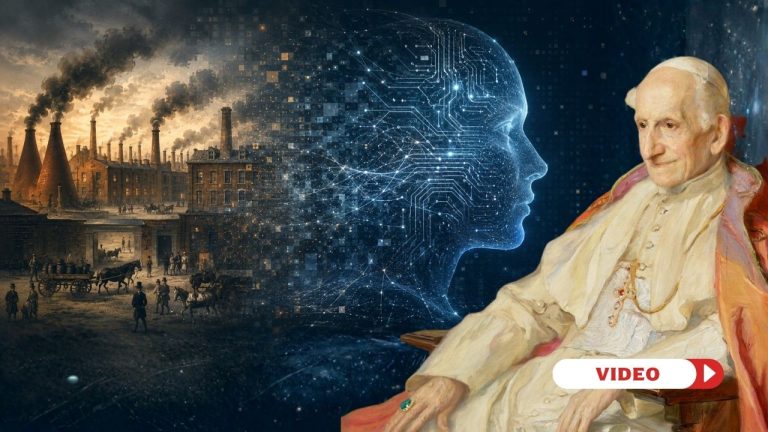
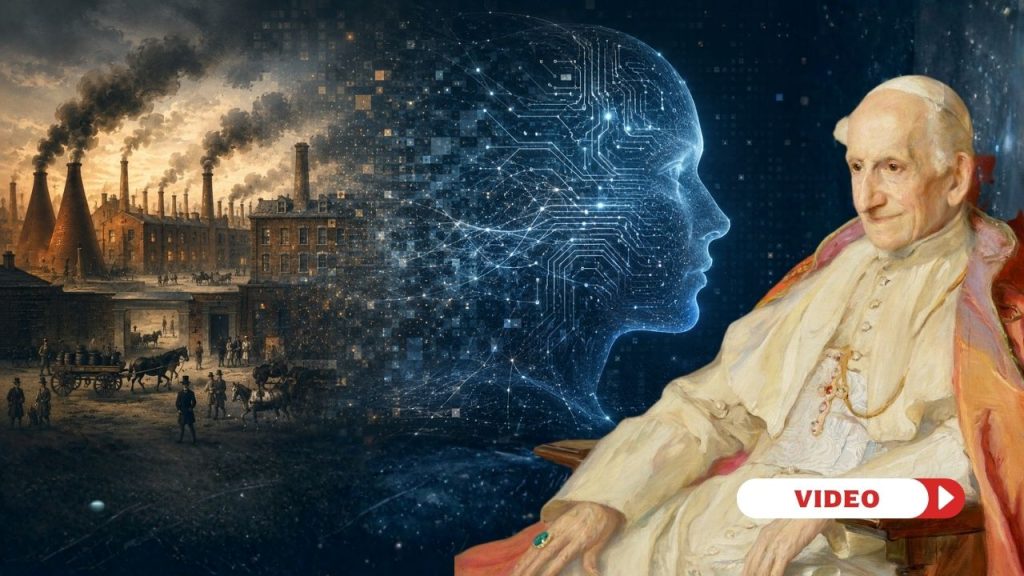
Just two days after his election, the new pope explained that his choice was inspired primarily by Pope Leo XIII, whose landmark 1891 encyclical Rerum Novarum addressed the social upheavals of the Industrial Revolution. Today, more than a century later, Pope Leo XIV sees humanity facing a similar moment of transformation—this time driven by artificial intelligence and the digital revolution.
Leo XIII to Leo XIV: Catholic Social Teaching
As he explained to the College of Cardinals, “Sensing myself called to continue in this same path, I chose to take the name Leo XIV. There are different reasons for this, but mainly because Pope Leo XIII in his historic Encyclical Rerum Novarum addressed the social question in the context of the first great industrial revolution.”
From the Industrial Revolution to the AI Revolution
When Pope Leo XIII was elected in 1878, industrialization was dramatically reshaping society. New technologies increased productivity and economic growth, but they also brought profound social consequences, especially for workers and their families.
According to Sr. Helen Alford, President of the Pontifical Academy of Social Sciences, “The whole economy had shifted, one based on coal as the power system and manufacturing became the central part of the economy. And that created a whole upheaval in terms of people’s lives. Work became a kind of commodity that you traded, like you trade other kinds of goods. So people lost their security.”
It was precisely this crisis that prompted Pope Leo XIII to publish Rerum Novarum, laying the foundations of modern Catholic Social Teaching. The document sought to preserve the benefits of economic progress while defending the dignity of workers and strengthening the institutions that protect human flourishing.
“One of the key things that the Pope is trying to do in Rerum Novarum is trying to find the best way to combine the advantages of the modern economy but also combine it with that security that got lost,” Sr. Alford explained. “And he basically has two ways of doing it. The first way is giving them access to private property so they can have a home, so they can have some kind of security for their family life as well. And the other way is coming together through associations.”
These ideas eventually developed into broader principles that continue to guide Catholic Social Teaching today, particularly solidarity and subsidiarity.
“You could in many ways say solidarity has been the main principle that’s helped people confront injustice in modern society,” Sr. Alford noted. “Then we have the principle of subsidiarity, which is really about helping people be protagonists, make decisions, have a sphere of influence over what is going on in their lives, exercise their freedom, all that kind of thing.”
Placing the Human Person at the Center
For Dr. Giulio Alfano, Deputy Director of Peace Sciences at the Pontifical Lateran University, these principles remain as relevant today as they were in the nineteenth century.
“Placing the person at the center means respecting his or her identity, but also entrusting States with a responsibility,” he said. “This is, in a way, the challenge of the Church today: the Church does not speak as a State, but speaks from the experience of her doctrine — placing at the center the urgency of the human person and, above all, calling on States to promote the human being in his or her greatest gifts.”
This emphasis on the intrinsic value of every individual is at the heart of Pope Leo XIV’s vision for the digital age.
As Sr. Alford succinctly puts it, “Everyone is a someone, not something! Because often we get people treated as instruments. People have an inherent dignity. They’re not just a resource. They’re not just a consumer. They’re someone with their own dignity. And that needs to be taken into account in our modern social and political and economic systems.”
In a world increasingly shaped by algorithms, automation, and data-driven decision making, the Church insists that human beings can never be reduced to economic units, consumers, or technological inputs.
A New Encyclical for a New Technological Age
Pope Leo XIV believes that the challenges posed by artificial intelligence require the same moral seriousness that the Church brought to the Industrial Revolution.
Addressing the cardinals shortly after his election, he observed: “In our own day, the Church offers to everyone the treasury of her social teaching in response to another industrial revolution and to developments in the field of artificial intelligence that pose new challenges for the defence of human dignity, justice and labour.”
That conviction would soon find fuller expression in his first encyclical, Magnifica Humanitas, published on May 25, 2026.
While Rerum Novarum addressed the social consequences of industrialization, Magnifica Humanitas seeks to provide a Catholic response to the digital age and the rapid development of artificial intelligence.
For Sr. Alford, the central question remains whether technology serves humanity or undermines it.
“Technology can be almost man’s enemy. So it could be man’s ally or almost man’s enemy. Why? Because all things, in the end have a good core. Even the things that get misused or abused, there’s something good in them that have been misused. Evil is parasitic on the good. And we can try to find something that’s good in all situations.”
One hundred and thirty-five years after Pope Leo XIII confronted the social challenges of factories, machines, and industrial capitalism, Pope Leo XIV is asking many of the same questions about algorithms, artificial intelligence, and digital power.
The technologies may have changed, but the Church’s answer remains rooted in the same conviction: every human person possesses an inviolable dignity that must never be sacrificed in the pursuit of progress. In every age—industrial or digital—the measure of a society is not its efficiency, but its ability to recognize that everyone is indeed someone, not something.
Adapted by Jacob Stein
Original post: https://ewtnvatican.com/articles/135-years-after-rerum-novarum-pope-leo-xivs-vision-for-human-dignity-and-ai