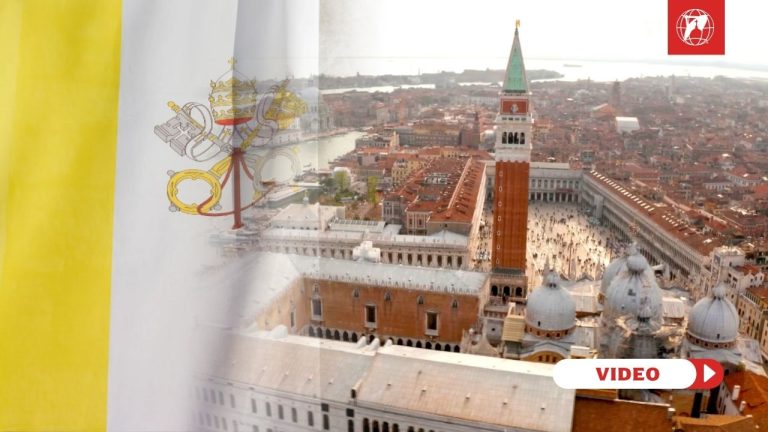
VENICE — Known throughout the world for its canals, gondolas, Carnival and cinema, Venice is also home to one of the most important international events in contemporary art: La Biennale di Venezia.
And among the 100 countries participating in this year’s International Art Exhibition is the Holy See, whose two pavilions invite visitors to encounter contemporary art through the extraordinary spiritual and artistic legacy of St. Hildegard of Bingen.
Bringing together 24 international artists across two locations in Venice, the Holy See’s project explores art, music, contemplation and care under a shared theme: “The Ear Is the Eye of the Soul.”
The World of Art Comes to Venice
Founded in 1895, the Venice Biennale has become one of the world’s leading international exhibitions of contemporary art and architecture.
The 61st International Art Exhibition, titled In Minor Keys and curated by Koyo Kouoh, opened May 9 and continues through Nov. 22.
Its exhibitions extend across the historic Giardini and Arsenale, as well as locations throughout Venice’s historic center and at Forte Marghera.
This year, 100 countries are represented through national pavilions, including seven participating for the first time.
Visitors come from around the world to discover emerging artistic movements and experience an extraordinary concentration of contemporary art.
“This is my second time at the Biennale. I’ve loved it,” one visitor told EWTN Vatican. “This year it’s so colorful. It’s so very optimistic.”
Another visitor, returning for a third time, described the Biennale as “the most interesting combination of art that you can see in a fairly short time.”
The Holy See at the Venice Biennale
Among this year’s participants, the Holy See has created a project spread across two distinct Venetian locations: the Santa Maria Ausiliatrice Complex and the Mystical Garden of the Discalced Carmelites.
Together, the pavilions feature 24 international artists and offer two different but complementary experiences.
Under the theme “The Ear Is the Eye of the Soul,” one is conceived as a living archive centered on restoration and care, while the other leads visitors through an immersive, contemplative journey involving nature, music and silence.
Connecting the two is a medieval saint whose interests crossed many of the boundaries separating modern academic and artistic disciplines: St. Hildegard of Bingen.
Why St. Hildegard of Bingen?
A 12th-century Benedictine abbess and Doctor of the Church, Hildegard was a mystic, theologian, writer, composer and student of the natural world.
For Ben Vickers, one of the curators of the Holy See Pavilion, Hildegard provides an alternative to the increasing specialization and fragmentation of modern life.
“We find her to be this magnificent, beautiful figure in the Church who is a polymath,” Vickers told EWTN Vatican.
“Since the period of Enlightenment, you have experienced the fragmentation of the arts and the fragmentation of disciplines into many different areas,” he explained.
Hildegard, he said, “shows us a different way of being.”
Her life brought together theology, music, medicine, language and mystical experience rather than treating them as isolated fields.
“She’s this incredible figure that shows us a way in which we can unify all of the disciplines,” Vickers said. “And we felt that in this moment, that is a critical step and an important thing to bring back to art.”
‘Open Work’: Art, Restoration and Care
The first Holy See pavilion, titled “Open Work,” is presented as a “Pavilion-Parable.”
Located at the Santa Maria Ausiliatrice Complex, the project approaches restoration itself as an act of care.
Visitors encounter installations, artworks and living archives exploring Hildegard’s spiritual and cultural legacy while considering how artistic practice can contribute to a more conscious and inclusive future.
The pavilion consequently moves beyond the idea of an exhibition as simply a place to observe finished objects. Instead, the process of caring for, preserving and restoring becomes part of the artistic experience itself.
A Mystical Garden Hidden in Venice
The second pavilion brings Hildegard’s vision into an entirely different environment: the Mystical Garden of the Discalced Carmelites.
Rather than constructing a temporary exhibition space, the Holy See placed the project within an existing garden already dedicated to contemplation and silence.
For Discalced Carmelite Father Jacopo, the decision allows the pavilion to become part of a living spiritual environment.
“What we’re hosting here at our Discalced Carmelite convent is phenomenal because the Holy See had this brilliant idea of placing the pavilion in a living space,” he told EWTN Vatican.
“It’s not a space built specifically for this purpose,” he explained. The convent’s Mystical Garden existed before the exhibition and was already “conceived as a place of contemplation and silence.”
It is within this natural setting that Hildegard’s musical and spiritual legacy finds perhaps its fullest expression.
Visitors are invited not simply to look at art but to slow down, listen and contemplate—allowing music, nature and silence to become part of the encounter.
Amid one of the world’s largest gatherings of contemporary art, the Holy See’s contribution ultimately proposes a different way of seeing: one that begins by learning how to listen.
Adapted by Jacob Stein