The pontiff denounced the use of science and technology for profit instead of moral and ethical human progress.
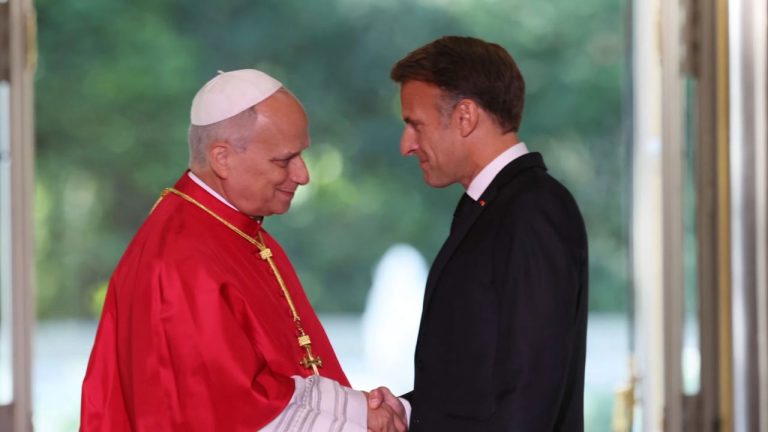
PARIS – Pope Leo XIV, in his first speech during a four-day visit to France, lamented the use of science and technology for profit instead of moral and ethical human progress and said that everyone is responsible for the protection of life.
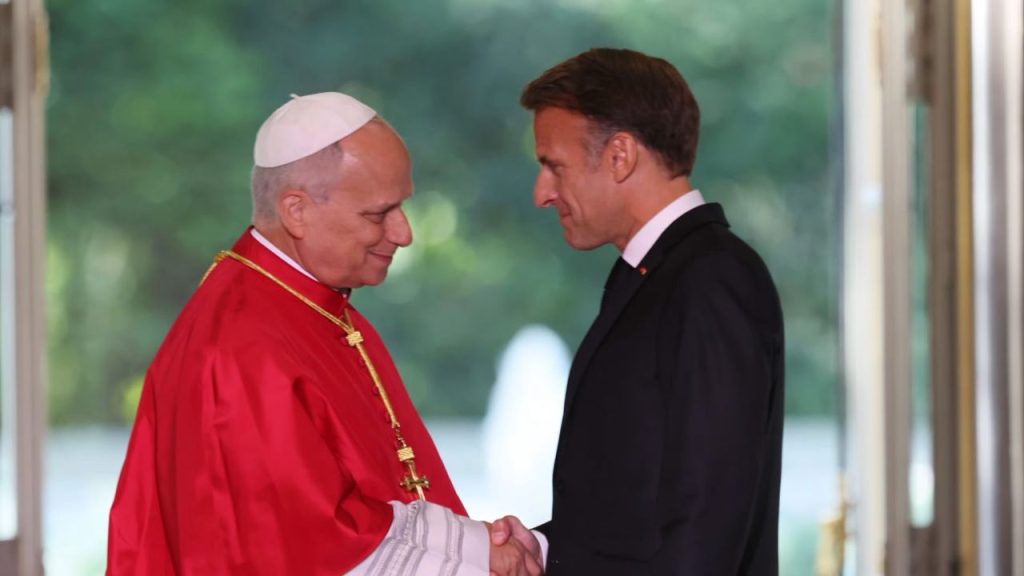
Addressing French President Emmanuel Macron and other government members at the Élysée Palace, the head of state’s official residence, on Sept. 25, the pontiff said he was concerned “by those trends in society that risk turning science and technology into profit-driven ventures promoting genetic manipulation, surrogacy, the trade in human organs or the possibility of arranging one’s own death.”
“Let us not forget that mutual respect and the protection of every human life is a duty incumbent upon each and every one of us,” he said.
End-of-life questions are among the most sensitive issues the pope is expected to address while in France Sept. 25-28. France legalized assisted suicide and euthanasia this summer, becoming the fifth European country to do so after Belgium, the Netherlands, Luxembourg, and Spain. In addition, Switzerland and Austria permit assisted suicide.
Euthanasia is the intentional ending of a person’s life to relieve suffering. It differs from assisted dying, in which the patient takes life-ending drugs himself, under a physician’s guidance. Both practices are prohibited by Catholic teaching.
The duty to protect and respect life, Leo continued, is “an expression of the authentic ‘secularity’ (laïcité) of the earthly city” since a “Christian engaged in public service and guided by the light of his or her conscience illumined by faith, cannot be considered a proselytizer or a threat to the unity of the nation.”
Laïcité is a legal principle strictly separating Church and state in France.
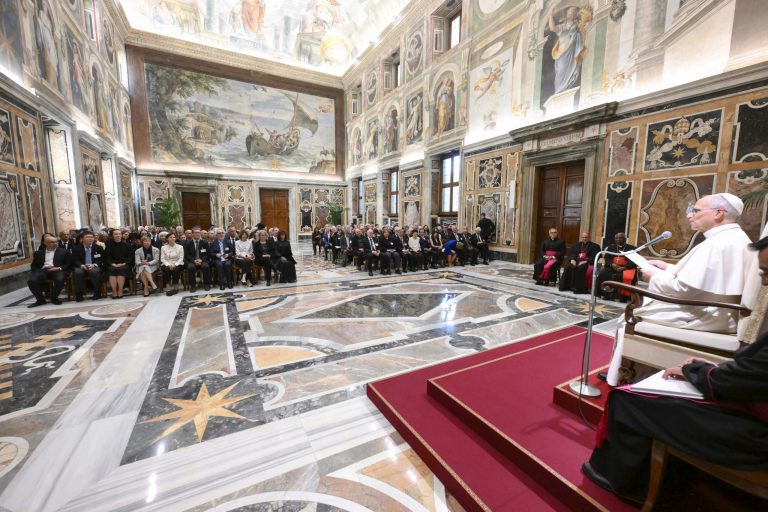
Leo urged the country’s political, civil and cultural leaders, as well as French and foreign diplomats, to see that “an authentic secularity” does not exclude religion but values it as an educational resource.
Leo echoed a 2018 speech by Macron, in which the president told the French bishops that “a Church that claims to be uninterested in temporal matters would not be fulfilling her vocation; and that a President of the Republic who claims to be uninterested in the Church and in Catholics would be failing in his duty.”
“An authentic secularity, then, consists not in excluding religion from the public sphere or from education, but in striving to ensure that the State and religious institutions maintain dialogue and join forces in the service of the common good, that the world may have life,” the pope said.
Speaking before the pope, Macron said that “it is precisely because France is a homeland of freedom and intellect that it is diverse. It is a nation that nurtures a particular passion for constant debate. One must understand it in this way in order truly to love it.” The two leaders met privately for 50 minutes before delivering their speeches.
Leo noted France’s “deep Christian roots” but also praised the French national motto of “liberty, equality, and fraternity” as a set of “ethical imperatives” and guides to follow as technology — including artificial intelligence — advances.
He cited the French Catholic author Georges Bernanos, who “saw the threat that blind obedience and irresponsibility could lead to a ‘Paradise of Machines,’ and pointed out that French civilization had instead sought for centuries to form free men and women who are fully responsible for their actions.”
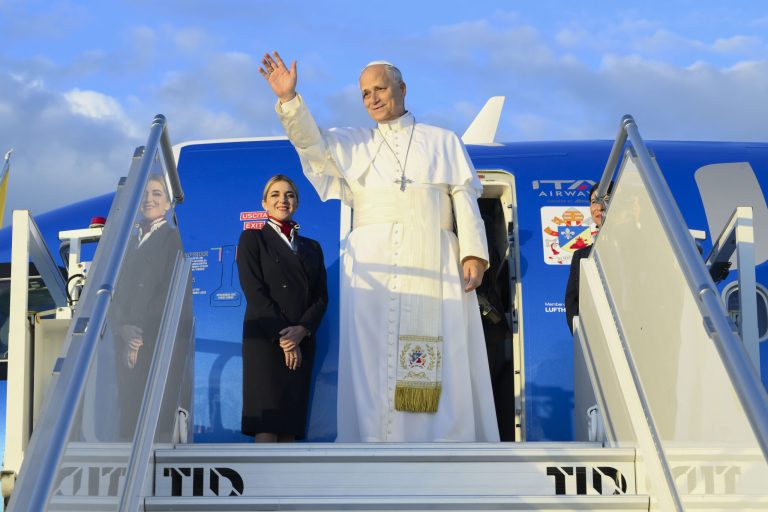
The pope, who earlier in the day told reporters accompanying him on the flight from Rome that he was traveling to France “as a follower of Jesus Christ who wants to bring peace of Christ throughout the world,” called in his speech for a ban on nuclear weapons and lamented war in the Middle East.
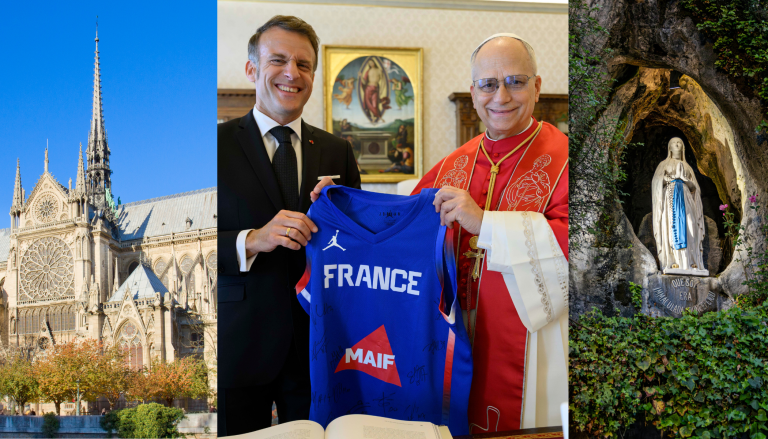
Also present for the pope’s address were firemen who responded to the 2019 fire at Notre-Dame Cathedral and artisans and architects who worked on the landmark’s subsequent restoration. The pope celebrated that undertaking, which he said “showed that something considered irreparably destroyed can be reborn through mutual cooperation.”
Pope Leo XIV landed in Paris on Friday for a four-day visit to France that began with a packed first day with stops at UNESCO headquarters, Notre-Dame, and the French national stadium for a prayer vigil with 80,000 young people. Leo is the first pope to visit Paris since Pope Benedict XVI in 2008.
Curious Parisians stopped what they were doing to watch the pope pass by in a car on his way from the airport to the center of Paris.
After a break for lunch, the Holy Father will visit the headquarters of UNESCO — the United Nations Educational, Scientific and Cultural Organization — a specialized UN agency that preserves cultural heritage sites and promotes peace, sustainable development, and human rights.
His journey will also bring him to the towns of Lourdes and Metz, before returning to Rome Sept. 28.
Follow the Live Updates of Pope Leo’s Trip in France available at EWTN News.
This article was originally published by EWTN News English.