ROME — More than 1,500 years after his death, the legacy of St. Benedict continues to shape the lives of thousands of monks around the world.
From his birthplace in Norcia to the caves of Subiaco and the Abbey of Montecassino, the life of the Father of Western Monasticism continues to inspire those seeking God through prayer, community, and work.
At the Pontifical University of Sant’Anselmo in Rome, the headquarters of the Benedictine Confederation, monks from across the globe continue living according to the Rule St. Benedict wrote fifteen centuries ago.
A global Benedictine family
Fr. Patrick Carter, O.S.B., Procurator General for the Benedictine Confederation, has spent the past eight years serving at Sant’Anselmo, one of the largest Benedictine communities in the world.
“We are here at Sant’Anselmo, which is sort of the global home of the Benedictine Confederation.”
“Saint Anselmo really has three entities which make it up: the school, the university — Pontifical University of Saint Anselmo — the College of Students, which live here, and then the Curia of the Benedictine Confederation, where I work and serve under the Abbot Primate.”
Today, nearly one hundred monks live, study, pray, and work together at Sant’Anselmo.
“Altogether, we are probably somewhere between 16,000 and 18,000 Benedictines in the world.”
From Rome to the cave of Subiaco
Born in Norcia during the fifth century, Benedict was sent by his wealthy family to Rome to pursue his education.
Disillusioned by life in the city, he left after only two years in search of a deeper relationship with God.
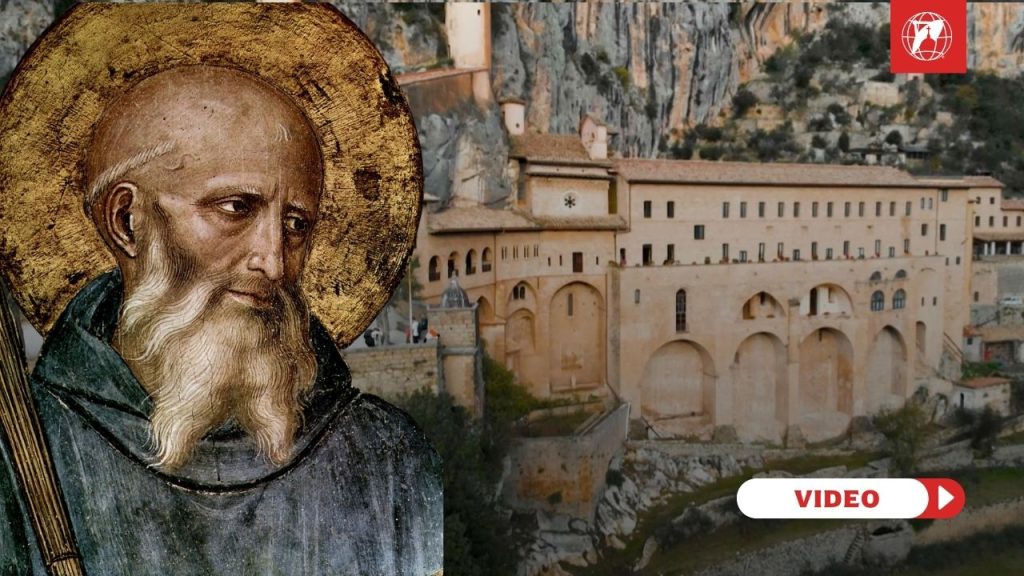
He eventually settled in Subiaco, where he lived for years as a hermit in the cave now known as the Sacro Speco. There he attracted disciples and began establishing the first Benedictine communities.
For Fr. Patrick, the place still speaks powerfully to visitors today.
“There’s something about Subiaco that really attracts one to the place and to the spiritual experience.”
“Set in a tight little valley, a monastery built around this little cave where Benedict somehow managed to survive for years and years.”
“It somehow draws one into this historical person and the reality of Saint Benedict and gives us some ability to contact him.”
The Rule that transformed Europe
Benedict later founded the Abbey of Montecassino around the year 529, where he composed the Rule of St. Benedict, centered on the balance of prayer and work.
More than fifteen centuries later, Fr. Patrick believes its emphasis on authentic community is perhaps even more relevant today.
“The Rule of Saint Benedict is a rule written for Cenobites, that means monks who live in community.”
“And I think that in our world today, we find ourselves more and more isolated by technology in many ways, that the advantages of communication actually take us physically apart.”
“Saint Benedict foresees a life in which monks are going to be sleeping in the same room, eating at the same table, praying together in the church.”
“A life with real human and physical presence with one another.”
“And I think that in society today, we really need to find opportunities to spend time in presence, in physical presence of other people.”
A legacy that endures
St. Benedict’s influence reached far beyond the monastery walls.
As the Roman Empire declined, his communities preserved not only the Christian faith but also elements of the civilization that had shaped Europe for centuries.
“Saint Benedict represents in some way the rebirth of culture at the end of the Roman Empire, where Christianity is increasing, but the central and stabilizing force of the Roman government was falling into ruin.”
“He is able to take some of the best aspects of the Roman culture which was then falling away, and to put those into a Christian and monastic setting which then allows the Church to preserve some of that Roman wisdom of government and order in the future Christian society which is going to be born in the Middle Ages and which the monasteries played a central role in.”
Known as the Father of Western Monasticism and the Patron Saint of Europe, St. Benedict’s witness continues to inspire new generations. From the monasteries of Norcia, Subiaco, and Montecassino to Benedictine communities around the world, his call to seek God through prayer, work, and life in community remains as relevant today as it was fifteen centuries ago.
Adapted by Jacob Stein.