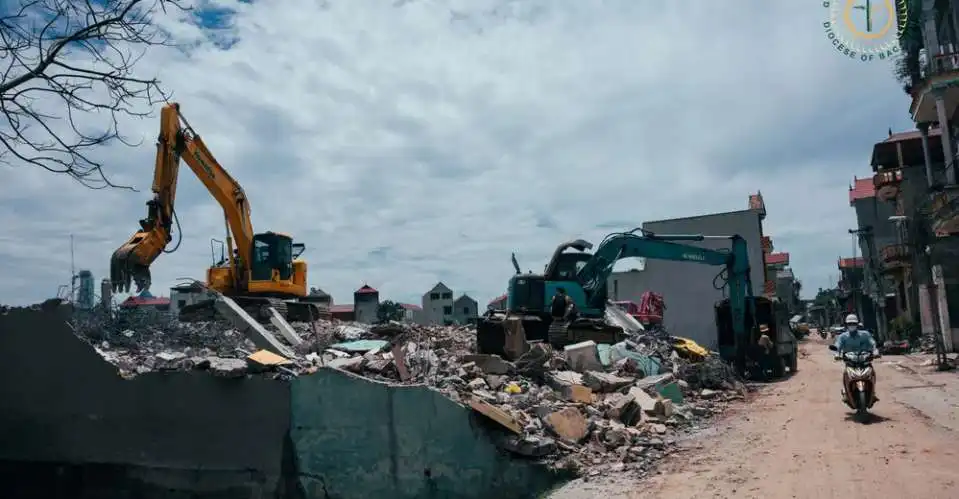
Houses of residents in Tu Ne Parish are torn down for the Gia Binh International Airport project on June 8. (Photo courtesy of https://giaophanbacninh.org)
BẮC NINH, Vietnam — In the villages of Bắc Ninh province, about 40 kilometers east of Hanoi, the sound of bulldozers has become the unwelcome soundtrack of daily life. The construction of Gia Binh International Airport, one of Vietnam’s largest infrastructure projects, is reshaping the landscape at a pace that leaves little room for grief. For the Catholic communities whose roots in this land stretch back nearly four centuries, what is being lost cannot be measured in money.
“There are losses that can be measured in money and land,” said Joseph Van Quy, a displaced resident. “But some pains cannot be measured by any number.”
Five Churches, Four Hundred Years of Faith
Five Catholic churches fall within the airport’s clearance zone, three of them belonging to Tu Ne Parish, a community whose Catholic history reaches back almost 400 years to the earliest days of the Church in northern Vietnam. The loss of these buildings is not simply a matter of bricks and mortar. For families who have worshipped, married, baptised their children, and buried their dead within these walls across many generations, the demolition represents the erasure of a living memory.
“People are losing not only homes and property but also memories, traditions, and faith communities built over many generations,” said Bishop Joseph Đỗ Quang Khang of Bắc Ninh, who met with provincial government officials on June 10 to raise the concerns of his people.
The bishop was careful to acknowledge the legitimate goals of national development. “The Church always supports the development of the country and appreciates projects that bring long-term benefits to society,” he said. “However, development only has meaning when people remain at its center”.
The Scale of the Disruption
The numbers alone are sobering. The nearly 2,000-hectare airport site will affect around 7,100 households. Of these, approximately 5,800 families, totalling about 52,000 people, are expected to be relocated as construction accelerates. Nearly 200 households from Tu Ne Parish alone have already moved into temporary shelters.
The disruption extends beyond the living. In Vietnamese culture, the graves of ancestors carry deep spiritual and emotional significance. As part of the project, family graves have already been exhumed and relocated to new cemeteries, a process that has added immense sorrow to the practical hardships of displacement.
One parishioner described the moment his family was forced to leave a newly built home just six months after completing its construction. “It is not only about money,” he said. “It is the loss of a dream that had only just begun”.
An elderly woman who moved into her son’s home after losing her own was soon displaced again when his house, too, fell within the demolition zone. Such repeated upheavals have left many residents in a state of persistent uncertainty.
Inadequate Compensation and Interrupted Care
The Church’s concerns are not limited to the spiritual. Clergy assisting affected communities have raised urgent questions about the adequacy of compensation and the conditions in temporary housing. Many families have already dismantled their homes, yet permanent resettlement sites remain incomplete. Some residents now occupy repurposed government buildings, often without consistent access to electricity or running water.
The situation is particularly acute for the Huong La Home, a care facility managed by the Sisters of Our Lady of Unity, which looks after 30 vulnerable children, including those with disabilities. The facility must also relocate, and the compensation offered for its agricultural land — approximately 90 million dong (US$3,450) per 350 square metres — is less than half the rate offered for nearby farmland. This disparity threatens the centre’s ability to continue its work.
Bishop Khang has called on authorities to guarantee stable housing, employment, education, and essential services for all families before requiring them to leave their homes and livelihoods. “The concerns of the people are also the concerns of the Church,” he said.
A Question of Priorities
The Gia Binh International Airport is a dual-use project, civilian and military, overseen by the Ministry of Public Security and groundbroken in August 2025. It is designed to serve the greater Hanoi metropolitan region and is part of Vietnam’s broader push to modernize its infrastructure. Provincial Vice Chairman Pham Van Thinh has acknowledged the sacrifices made by residents and pledged to continue engaging with communities to find practical solutions. Officials have stated that no resident should be left behind.
Yet for the people of Tu Ne Parish, the gap between official assurances and lived reality remains wide. As one resident, An Binh, put it: “When will this temporary life end? Will the new place truly become a peaceful home? Will we still gather around our church and hear the bells that accompanied previous generations?”
His question is not merely practical. It is a question about whether the Church — the gathering of the faithful, not just the building, can survive the scattering of its people.
A Church That Speaks for the Voiceless
The response of Bishop Khang and the clergy of Bắc Ninh Diocese reflects a long tradition in the Vietnamese Church: speaking plainly on behalf of those who cannot easily speak for themselves. The Church in Vietnam has navigated decades of restrictions on its public role, and its willingness to engage directly with government officials on behalf of displaced families is itself a form of courage.
The Church does not oppose development. It insists, as it always has, that the measure of any development project is not the speed of its construction but the welfare of the people it displaces. As the Catechism of the Catholic Church teaches, the goods of the earth are meant for all, and the right to private property does not override the universal destination of goods (CCC 2402–2403).
As we pray for the Catholic communities of Bắc Ninh and all those displaced by the Gia Binh airport project, the solution we can recommend as Catholics are:
- The Sacrament of Confession: To examine our own hearts for indifference to the suffering of those uprooted by forces beyond their control, and to seek the grace to act with greater solidarity.
- Eucharistic Adoration: To bring before the Lord the grief of families who can no longer gather in their parish churches, asking Him to be their true and lasting home.
- The Holy Rosary: To entrust the displaced communities of Bắc Ninh to Our Lady, asking her intercession for just compensation, safe resettlement, and the preservation of their faith communities.
- The Holy Mass: To participate with gratitude for the gift of our own parish communities, and to pray for the day when the faithful of Tu Ne Parish will once again hear the bells of their church.
- Sacred Scripture: To meditate on the words of the Prophet Micah: “They shall sit every man under his vine and under his fig tree, and no one shall make them afraid” (Micah 4:4), and to commit ourselves to supporting every effort to protect the rights of the poor and the displaced.
To remain informed about Catholic life, teachings, and global Church developments, readers may be encouraged to visit www.ewtnvatican.com for trusted Catholic news from Asia.