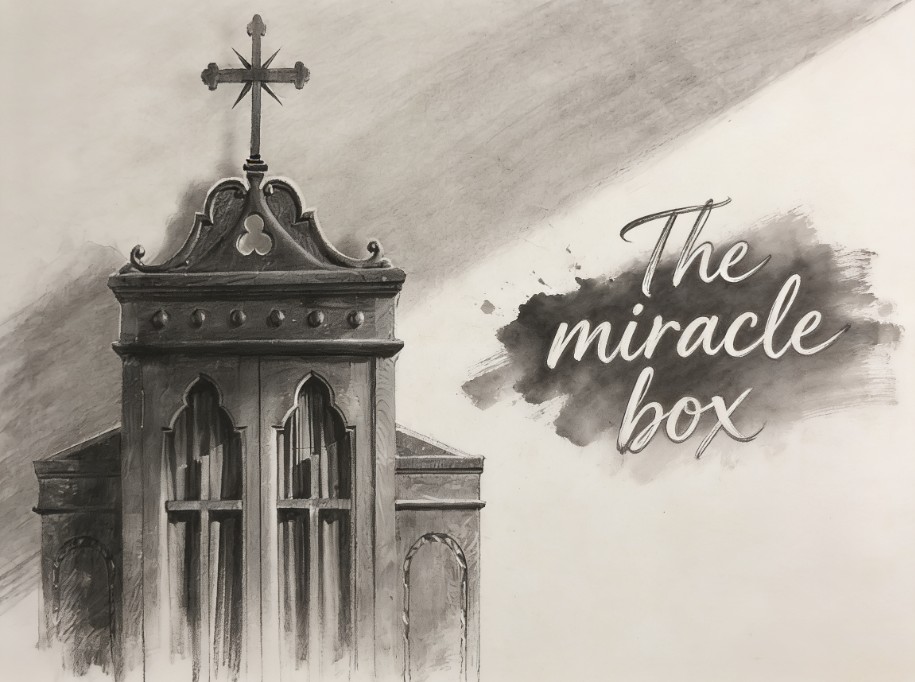
For many Catholics, the confessional remains one of the most misunderstood corners of the faith, associated more with hesitation and unease than with the grace it was designed to offer. A documentary exploring exactly that tension, why so many believers quietly avoid one of the Church’s most powerful sacraments, has been drawing renewed attention for the way it reframes Confession entirely. Titled The Miracle Box, the hour-long film follows real people whose encounters with the Sacrament of Confession became turning points in their lives, offering a rare, intimate look at what happens when someone walks into that small, quiet space.
Inside The Miracle Box: A Documentary on the Sacrament of Confession
The Miracle Box was created by Father John Clote, a former broadcast journalist who reported for outlets including NBC, ABC, and PBS before entering religious life. That journalistic background shows throughout the film, which unfolds less like a catechism lesson and more like an investigative piece, built around firsthand personal testimonies, never-before-seen interviews, and commentary from respected theologians and confessors. Produced by the team behind the earlier film Ocean of Mercy and narrated by veteran broadcaster Bill Kurtis, the documentary runs approximately 58 to 60 minutes and carries a TV-PG rating suitable for family viewing.
The film’s central thread ties directly into the message of Divine Mercy revealed to St. Faustina Kowalska, framing Confession not as a ritual obligation but as a direct, ongoing invitation from Christ to encounter mercy in a tangible way. Rather than treating the sacrament abstractly, The Miracle Box lets its subjects describe, in their own words, what changed in them after that encounter, offering viewers something more persuasive than any theological argument alone could provide: lived experience.
Why ‘The Miracle Box’ Speaks to a Common Struggle With Confession
Father Clote has been candid about what he believes keeps so many Catholics away from the confessional in the first place: fear, pride, and simple ignorance about what the sacrament actually offers. Many people, he has explained, have absorbed a distorted picture of Confession as an exercise in humiliation rather than what it truly represents, an opportunity for healing, compassion, and spiritual growth.
One of the film’s most striking moments features Dr. Scott Hahn, the well-known Catholic theologian, comparing the priest’s words of absolution to Christ’s command that raised Lazarus from the dead. Where that miracle restored physical life, Hahn notes, absolution restores something even greater: eternal life. Fr. Richard Simon, familiar to many from his radio program “Father Simon Says,” adds further theological depth throughout the film, helping viewers understand not just the emotional impact of Confession but its deeper spiritual mechanics.
Why This Documentary Holds Real Significance for the Church Today
The Miracle Box arrives at a moment when participation in Confession has been declining for decades across much of the Catholic world, even as interest in personal healing, mental health, and authentic transformation continues to grow in the wider culture. That gap, a sacrament uniquely designed for healing being quietly avoided by the very people who might benefit most from it, is precisely what this documentary attempts to close. By combining raw personal testimony with serious theological reflection, the film offers both pastoral leaders and everyday Catholics a fresh, accessible resource for reintroducing Confession to people who may have drifted away from it entirely.
For parishes and families looking for material that explains the sacrament in approachable, emotionally resonant terms rather than dry catechetical language, this kind of storytelling fills a real and ongoing need in faith formation.
The Confessional as a Door Back to God
At the heart of The Miracle Box is a single, quietly profound question: could the confessional be the door that leads back to the heart of God? That framing captures something essential about Catholic teaching on this sacrament. Confession was never intended to dwell on shame; it exists specifically so that shame does not have the final word. Each testimony featured in the film illustrates the same underlying pattern described throughout Scripture, a return, an encounter with mercy, and a restoration that could not have happened through willpower alone.
Where to Watch the Miracle Box

Viewers interested in exploring this documentary further can find The Miracle Box available to stream through EWTN On Demand, alongside a wide library of other Catholic programming. It is also available through EWTN Flix, a streaming app designed specifically for Catholic audiences, downloadable on the App Store for iOS devices or on Google Play for Android, for those who prefer watching on a mobile device or tablet. It can also be streamed directly through EWTN Asia Pacific’s watch page. Coverage and recommendations of programming like this, including from platforms such as EWTN Asia Pacific News, continue to help Catholic audiences discover documentaries that might otherwise stay under the radar.

A Spiritual Resolution
The deeper spiritual resolution offered by this documentary is not complicated, even for those who have avoided Confession for years, or have never fully understood its purpose. Fear and pride tend to grow heavier the longer they go unaddressed, while mercy, once actually encountered rather than merely imagined, tends to dissolve both far more quickly than expected. The stories featured in The Miracle Box suggest a simple but often overlooked truth: the hardest part of Confession is rarely the sacrament itself, but the anticipation leading up to it.
- Confession, which clears away the fear, pride, and shame that keep so many believers at a distance from God in the first place, exactly the barrier The Miracle Box spends its runtime dismantling.
- Adoration, quiet time spent in Christ’s presence that allows the peace received in Confession to settle and deepen, rather than fade the moment life returns to its usual pace.
- The Rosary, a steady, repeated rhythm of prayer that anchors the ordinary days in between, keeping the heart oriented toward Christ through Mary’s own example.
- The Eucharist, the point where grace received elsewhere culminates in the fullest possible union with Christ.
- Scripture, returned to often, grounding this entire rhythm in God’s own word, a reminder that mercy, healing, and restoration were never invented by the Church, but revealed by God from the very beginning.
Taken together, these five practices offer exactly what The Miracle Box points toward without stating outright: mercy encountered once in the confessional is meant to be carried forward, not left behind as a single isolated moment, but sustained through prayer, presence, and the ongoing rhythm of the sacramental life.
The Miracle Box doesn’t rely on spectacle to make its case. Instead, it lets real testimony, careful theology, and a journalist’s attentive eye do the work, building a portrait of Confession as something far richer than fear or misunderstanding often allow it to be. Whatever a viewer’s own relationship with this sacrament may be, the documentary offers a thoughtful, human-centered lens on a subject too often reduced to obligation rather than encounter.
To remain informed about Catholic life, teachings, and global Church developments, readers may be encouraged to visit www.ewtnvatican.com for trusted Catholic news and resources.