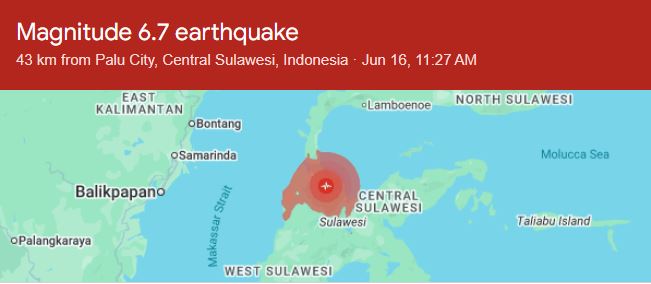
PALU, Indonesia — A powerful 6.7 magnitude earthquake struck the central Indonesian island of Sulawesi on Tuesday, June 16, 2026, killing at least one person, injuring dozens, and sending panicked residents fleeing into the streets of a city still haunted by a devastating disaster eight years ago.
The initial quake, which struck inland about 43 kilometers east-southeast of Palu at a depth of 10 kilometers, caused strong shaking that lasted for more than a minute. It was followed by at least 71 aftershocks throughout the day, the strongest measuring 5.2 in magnitude.
For the 400,000 residents of Palu, the capital of Central Sulawesi province, the tremors brought back terrifying memories of the 2018 magnitude 7.5 earthquake and subsequent tsunami that killed more than 4,000 people and swallowed entire neighborhoods through soil liquefaction.
“The earthquake shaking was extremely strong,” said Palu resident Muhtar Ahmad. “We are still traumatized by the previous earthquake, so we chose to remain outside because we are afraid that aftershocks may continue”.
Widespread Damage and Disruption
The National Disaster Management Agency reported that the hardest-hit area was the Sigi regency. Across the affected region, the earthquake caused widespread damage to infrastructure, including 67 houses, six places of worship, four public facilities, two bridges, two government office buildings, and three business sites. A section of a provincial road linking Palu city with the neighboring regencies of Sigi and Poso was also cut off.
At least 312 people have been displaced by the quake. One person has died, and 38 others were rushed to nearby hospitals, including 13 with serious injuries.
The strong shaking prompted several hospitals in Palu to evacuate patients outdoors as a safety measure, with some patients seen sitting on the grass still attached to their IV drips. Hotels also cleared their buildings.
“We have evacuated all guests from the hotel, including several guests who remained in their rooms,” said Effendi Natali, a general manager of a four-star hotel in Palu. “They all panicked, which is a natural reaction during an earthquake, but everyone is safe”.
Footage from the area showed heavily damaged structures with partially collapsed roofs, shattered walls, and debris scattered across the streets. Video also captured churchgoers in Kota Palu scrambling to exit their building as the quake struck.
A Region Prone to Disaster
Indonesia, a vast archipelago of more than 17,000 islands, sits on the Pacific “Ring of Fire,” an arc of volcanoes and fault lines that makes the country highly prone to seismic and volcanic activity.
The people of Sulawesi are no strangers to this reality. In addition to the 2018 Palu disaster, a magnitude 6.2 earthquake near the city of Mamuju in January 2021 left at least 100 people dead and forced thousands to sleep outdoors for days out of fear of aftershocks.
Following Tuesday’s quake, many residents moved away from coastal areas as a precaution, fearing a tsunami. However, Indonesia’s Meteorology, Climatology, and Geophysical Agency confirmed there was no tsunami threat, though they warned that aftershocks could continue.
The Church’s Response
In times of crisis, the Catholic Church in Indonesia has consistently stepped forward to provide immediate relief and long-term support. Following the 2018 disaster, Caritas Indonesia (Karina) and the local Archdiocese of Makassar played a crucial role in delivering emergency supplies, clean water, and shelter to survivors.
While the full extent of the damage from this latest earthquake is still being assessed, local parishes and Catholic relief agencies are already mobilizing to assist those who have been displaced or injured. The Church’s presence offers not only material aid but also spiritual comfort to a community that has endured repeated trauma.
As we pray for the people of Sulawesi, let us continue to go to:
- The Sacrament of Confession: To examine our hearts for times we have failed to trust in God’s providence during moments of fear or uncertainty, and to seek His peace.
- Eucharistic Adoration: To spend time before the Blessed Sacrament, praying for the soul of the person who died in this earthquake, for the healing of the injured, and for the comfort of those who are traumatized.
- The Holy Rosary: To ask the Blessed Virgin Mary to wrap her mantle of protection around the people of Indonesia, especially those sleeping outdoors in fear of aftershocks.
- The Holy Mass: To offer our participation in the Mass for the strengthening of the local Church in Sulawesi, that it may continue to be a beacon of hope and practical help.
- Sacred Scripture: To reflect on Psalm 46: “God is our refuge and strength, a very present help in trouble. Therefore, we will not fear, though the earth should change, though the mountains shake in the heart of the sea.”

To remain informed about Catholic life, teachings, and global Church developments, readers may be encouraged to visit www.ewtnvatican.com for trusted Catholic news and resources.