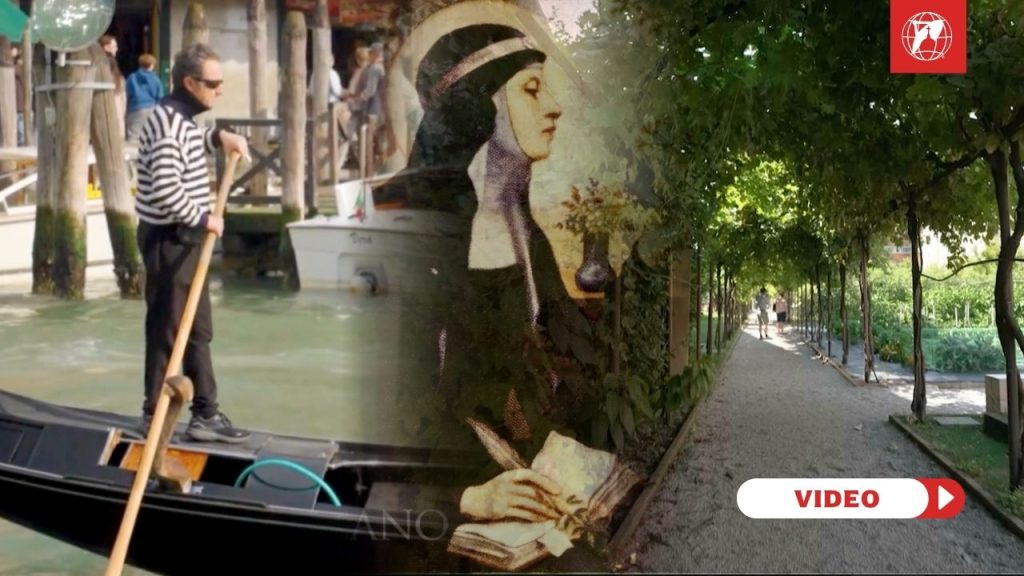
Just steps from the crowds and constant movement of Venice’s Santa Lucia railway station, visitors can enter an unexpected oasis of silence, music and prayer.
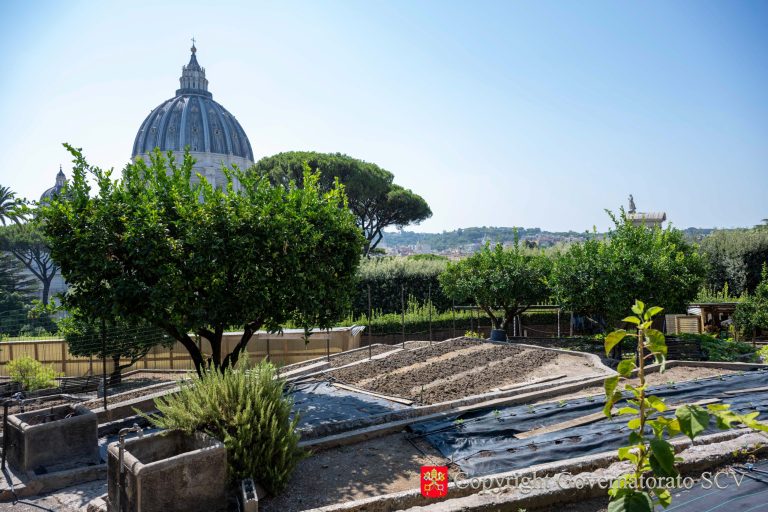
The Holy See’s pavilion in the garden of the Discalced Carmelites invites visitors to slow down and rediscover harmony through nature and sound, guided by the spirituality of St. Hildegard of Bingen.
A Mystical Garden in the Heart of Venice
Upon entering the garden, visitors receive headphones connected to antennas positioned throughout the grounds. As they move from one area to another, the music changes with them.
“Depending on where they are in the garden, visitors wearing the headphones will hear different pieces of music—about twenty works by different contemporary composers who created music specifically for the garden,” Father Ermanno Barucco, O.C.D., of the Mystical Garden of Venice, told EWTN.
The result is a multi-sensory journey in which music, plants, fragrances and silence become part of a single experience.
At its center is the extraordinary figure of St. Hildegard of Bingen, the medieval Benedictine abbess, mystic and Doctor of the Church who serves as a guiding inspiration for the Holy See’s pavilions.
“Hildegard of Bingen, a nun from the Middle Ages, developed a deep and special connection with nature, medicinal herbs, and art—both visual and musical,” Father Barucco explained.
Rediscovering Hildegard’s Symphony
Hildegard was not only a mystic and theologian but also a poet and composer who left behind an extraordinary collection of sacred music.
Among her musical works is the collection commonly known as the Symphonia armonie celestium revelationum, or Symphony of the Harmony of Celestial Revelations.
Music occupied a particularly important place in Hildegard’s vision of the human person and creation. She understood the Fall as a loss of the original harmony of Paradise and saw sacred music as a means through which humanity could once again turn toward the harmony for which it was created.
That vision makes Hildegard a natural inspiration for a pavilion experienced primarily through listening.
Father Barucco noted that while the medieval saint remains less familiar to many Italians, she has exercised a significant cultural influence elsewhere.
“Hildeard is a well-known figure in the Germanic and English-speaking worlds—much more so than in Italy—as a cultural inspiration, much like St. Francis in Italy, we might say,” he said.
That influence, he explained, meant that several of the artists involved in the project already had a connection with Hildegard and wanted to explore her thought through music.
From Venice’s Crowds to an Oasis of Calm
Since opening, the garden has attracted visitors from a wide variety of backgrounds. Reservations are required, with no more than 40 people admitted to explore the space at one time.
Many arrive simply out of curiosity, and not all are Catholic.
For some, the most striking aspect of the experience is the contrast between the garden and the crowded streets, canals and transportation hubs immediately outside.
One visitor told EWTN that she had already returned for a second visit after unexpectedly discovering the garden while heading toward the nearby train station.
“It was so nice because it was really hot and it’s lovely to just relax and listen to the music and experience the garden,” she said.
The experience went beyond sound. She recalled the fragrances of lavender and other herbs filling different parts of the garden.
Another visitor described the experience as “really spiritual” and “very calming,” particularly amid the crowds that fill Venice.
“It’s really nice being somewhere in the busyness of everything, especially lots of tourists, myself included, to have a calm space,” she said.
A Surprising Vatican Presence
The garden combines hundreds of plants and fragrances with compositions and sound works connected to contemporary artists and musicians, including Patti Smith and Brian Eno.
For some visitors, another surprise comes only after experiencing the garden: discovering that the project is connected to the Holy See.
One visitor described the space as a dramatic contrast with the “total chaos” of the nearby railway station.
“It was interesting to find out that it’s actually a Vatican contribution to the Biennale,” the visitor said. “So it was a nice surprise.”
Another said the spiritual dimension of the soundscape was stronger than expected.
“A lot of the choral music and everything, it was a lot more of the spiritual side of it than I was expecting,” the visitor explained. “I didn’t know really completely what to expect, but it was brilliant.”
“The Ear Is the Eye of the Soul”
The experience ultimately asks visitors to do something increasingly difficult in the modern world: slow down and listen.
That invitation reflects the theme of the Holy See’s pavilions: “The ear is the eye of the soul.”
For Father Barucco, the beauty of the natural world provides an opening through which visitors can move from exterior silence toward interior reflection.
“Through the beauty of creation, through the beauty of nature, many people say they find silence, harmony, and peace,” he said.
Listening to music can then draw visitors further inward, beginning a search for peace that connects the artistic experience of the pavilion with Hildegard’s spiritual vision.
The journey, Father Barucco explained, can lead people to discover not only “the harmony of music found in nature” or the harmony human beings create with voices and instruments, but something deeper.
It can lead them, he said, to discover “the harmony that God has placed deep within, in the depths of one’s own heart.”
Adapted by Jacob Stein