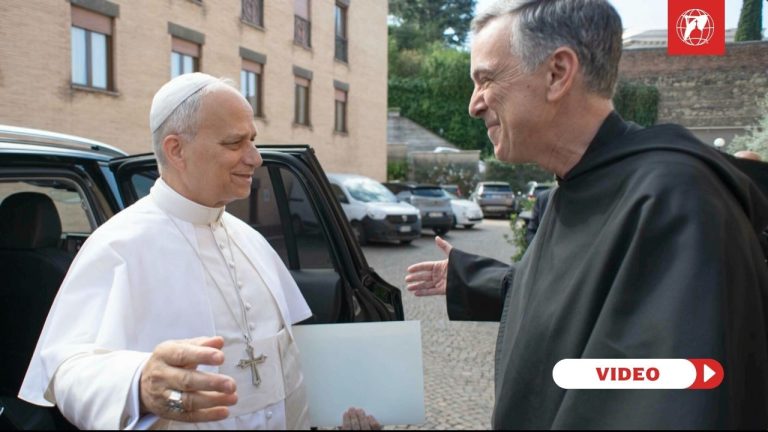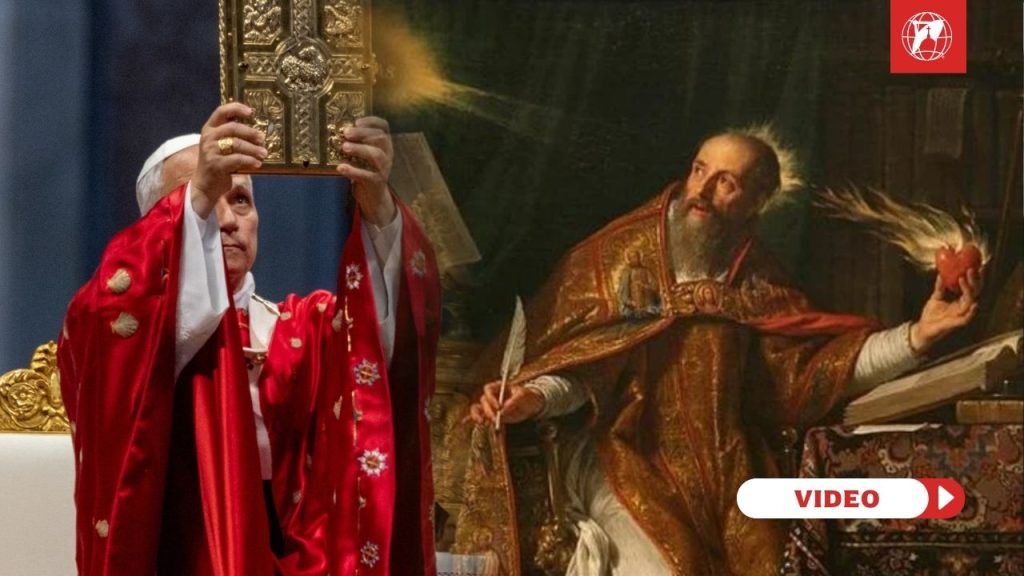
“I am a son of St. Augustine, an Augustinian.”
With those words on the day of his election, Pope Leo XIV introduced the world not only to his religious identity, but also to one of the strongest spiritual influences on his life.
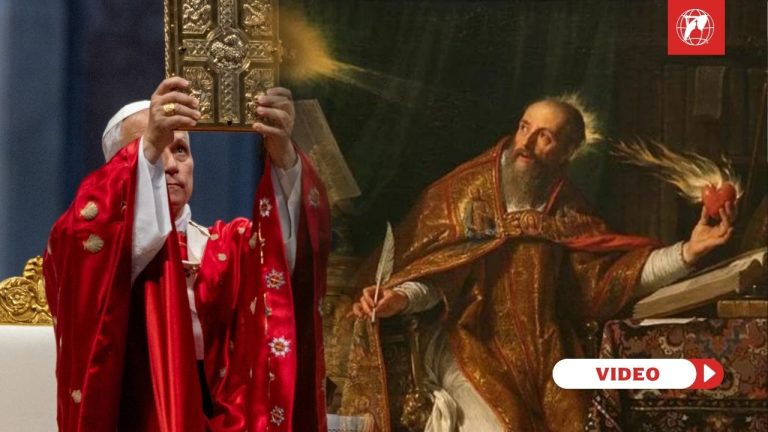
Since then, the first Augustinian pope has repeatedly turned to St. Augustine of Hippo in his homilies, speeches and encounters with the faithful. From the human search for truth to questions of justice, politics, unity and peace, the fourth-century saint has become a recurring voice in Leo’s pontificate.
For Pope Leo, however, quoting Augustine is about more than citing one of Christianity’s greatest thinkers. Augustine offers a way of understanding the human person, the Church and its place in the world.
“Our Heart Is Restless Until It Rests in You”
Pope Leo placed St. Augustine at the center of his message from the beginning of his ministry.
During his inauguration Mass in St. Peter’s Square, the Pope quoted perhaps the most famous passage from Augustine’s Confessions: “You have made us for yourself, and our heart is restless until it rests in you.”
Those words capture the story of Augustine himself.
Born in North Africa in 354, Augustine spent much of his youth searching for happiness and truth. His journey led him through worldly ambitions, intellectual pursuits and different philosophical and religious ideas before his conversion to Christianity.
That experience of restlessness has remained one of the most recognizable aspects of Augustine’s spirituality. The human heart desires something that worldly success, pleasure or achievement alone cannot satisfy.
Centuries later, Pope Leo brought that same message to a new generation during the Jubilee of Youth.
“Centuries ago, Saint Augustine understood the deepest desire of our hearts, the desire of every human heart, even without the technological developments of today,” Leo told the young people gathered for a prayer vigil. “He too had a restless youth, but he did not settle for less, he did not silence the cry of his heart.”
The Pope again turned to the Confessions, presenting Augustine’s search not simply as an ancient conversion story, but as an answer to questions young people still ask today about identity, happiness and meaning.
More Than Quotations
Robert Francis Prevost’s connection to Augustine began long before his election as Pope Leo XIV.
As a member of the Order of St. Augustine, he spent decades immersed in Augustinian spirituality and served as Prior General of the Order from 2001 to 2013.
That formation remains visible in his teaching as pope.
Fr. Pasquale Cormio, rector of the Basilica of St. Augustine, said Augustine frequently appears in Leo’s addresses, but the connection goes deeper than the quotations themselves.
“The Pope also wants to help us understand, we could say, a vision of the Church and a testimony of faith that comes through Augustine’s teaching,” he explained.
Among the Augustinian themes that repeatedly emerge are the search for truth, the practice of charity, the pursuit of unity and the responsibility of Christians to work for justice and peace.
Another of Augustine’s works has proved particularly relevant: The City of God.
What Is St. Augustine’s ‘City of God’?
Augustine began writing The City of God after the sack of Rome in 410, at a time of profound uncertainty in the Roman world.
Some blamed Christianity for Rome’s decline, arguing that abandoning the traditional pagan gods had weakened the empire. Augustine responded by examining history, political power and the ultimate destiny of humanity from a Christian perspective.
Pope Benedict XVI later described the work as crucial to the development of Western political thought. More than 1,600 years after it was written, Pope Leo has also pointed to its relevance.
“Although the context in which we live today is different from that of the fifth century, some similarities remain highly relevant,” Leo has said.
Central to Augustine’s vision are two “cities” that coexist throughout human history: the City of God and the earthly city.
As Pope Leo explained, the City of God is characterized by the love of God — amor Dei — and love of neighbor, especially the poor. The earthly city, by contrast, is marked by pride, self-love — amor sui — and the pursuit of worldly power and glory.
The distinction does not mean that Christians should abandon earthly society and wait for heaven.
Quite the opposite.
Christians Are Called to Engage the World
Augustine taught that Christians live in the earthly city while keeping their hearts directed toward their true homeland in God.
For Pope Leo, that means Christians cannot consider themselves strangers to political or social life. Guided by Scripture and Christian ethics, they are called to contribute to the societies in which they live.
At the same time, Leo has stressed that The City of God should not be treated as a blueprint for a Christian political system.
The work “does not propose a political program,” he has said. Instead, Augustine provides insights into fundamental questions of social and political life, including how peoples can pursue greater justice and peaceful coexistence.
This distinction remains important in Leo’s own teaching. Christian faith should shape how believers approach society, but the Gospel cannot be reduced to a political ideology.
Augustine’s warning about the corrupting effects of pride, power and self-interest also remains strikingly current.
“A State Without Justice Is Not a State”
One of the strongest connections between Augustine’s political thought and Pope Leo’s teaching concerns justice.
During the Jubilee of Justice, Leo invoked Augustine’s warning that political authority cannot be separated from moral responsibility.
“A state without justice is not a state,” the Pope said.
He then called those responsible for administering justice to understand their work as a service to the people, always respecting law and the dignity of every person.
“May these demanding words of Saint Augustine inspire each of us to express the exercise of justice as a service of the people, to the best of our ability,” Leo said, calling on his listeners to keep their gaze fixed on God.
The message reflects a recurring Augustinian tension: Christians belong ultimately to the City of God, yet that does not free them from responsibility for the earthly city.
Their faith should instead affect how they pursue justice, exercise authority and treat other people.
Truth, Charity, Unity and Peace
Across Augustine’s enormous body of writings, several themes continually return: the search for truth, love of God and neighbor, communion within the Church, and the pursuit of peace.
They are also themes that have become increasingly recognizable in Pope Leo’s ministry.
Perhaps nowhere is the connection more personal than in the motto Leo chose years before becoming pope: In Illo uno unum.
The expression comes from St. Augustine and can be translated as “In the One, we are one.”
“Unity has always been a constant concern of mine,” Pope Leo has explained, pointing to the motto he chose for his episcopal ministry.
The “One” is Christ. Christians may be many, come from different backgrounds and possess different gifts, but in Christ they become one.
For an Augustinian, that emphasis on unity is particularly significant. Community and communion stand at the heart of the Rule of St. Augustine, which calls Christians to live together “of one mind and one heart intent upon God.”
Augustine’s Voice in the 21st Century
St. Augustine died in 430, but the questions he confronted have not disappeared.
What can satisfy the restless human heart? What makes a society just? How should Christians relate to political power? How can unity survive disagreement? And where can lasting peace be found?
The historical circumstances have changed dramatically, but Pope Leo believes Augustine’s insights still have something to say.
That is why the saint appears so frequently in his teaching. Augustine is not simply a historical figure whom the first Augustinian pope happens to admire. His thought provides Leo with a language for addressing some of the central challenges facing Christians today.
From the restless heart of the Confessions to the struggle between love of God and self-love in The City of God, Augustine continually directs the person beyond self-interest and toward God, neighbor and communion.
More than 16 centuries after the Bishop of Hippo’s death, his voice continues to be heard.
And through the ministry of a pope who proudly calls himself a “son of St. Augustine,” that voice is reaching a new generation.
Adapted by Jacob Stein.