Ahead of the United Nations’ World Day Against Trafficking in Persons on July 30, Catholic sisters took their message directly to the streets of Jakarta, warning residents about a threat that rarely looks dangerous at first glance: a job offer that arrives through a phone screen. According to Indonesia’s Foreign Ministry, roughly 10,000 Indonesians were lured into online scam operations across ten countries between 2020 and the end of 2025, many of them trafficked, coerced, and forced into criminal activity far from home. The nuns’ public demonstration was a direct response to that growing crisis, one increasingly built not on back alleys and smuggling routes, but on convincing online job postings.
The Numbers Behind the Crisis: Why Indonesia’s Foreign Ministry Is Sounding the Alarm
Indonesia’s government has been tracking this problem closely, and the figures paint a troubling picture of scale. Officials have confirmed thousands of cases of Indonesian citizens found embroiled in online scam operations across countries including Cambodia, Myanmar, and the Philippines, with financial losses linked to online scams reaching hundreds of millions of dollars in a single year. Deputy Foreign Minister Arrmanatha Nasir has described the crisis as a matter of human security, not simply law enforcement, warning that no country can confront the problem alone.
The pattern behind these numbers is consistent: victims are typically offered legitimate-sounding jobs, often in customer service or tech support, only to be trafficked across borders and coerced into running the very scam operations they were promised employment with. Many victims are held under threat of violence, with escape made deliberately difficult. The United Nations estimates that as many as 120,000 people may currently be held in scam centers in Myanmar alone, underscoring that Indonesia’s crisis is part of a much larger regional and global pattern of exploitation.
Talitha Kum: The Global Network of Nuns Fighting Trafficking on the Ground
The sisters marching through Jakarta’s streets are part of Talitha Kum, an international network of Catholic religious women founded in 2009 under the International Union of Superiors General, now active in 113 countries. Public demonstrations like this one are a deliberate part of the network’s education and awareness strategy, alongside school visits, parish outreach, street theater, and social media campaigns designed to help vulnerable populations recognize trafficking risks before they fall victim to them.
Talitha Kum’s global reach continues to grow, assisting 1.21 million people in 2025, nearly 30 percent more than the previous year. International coordinator Sister Abby Avelino said traffickers increasingly exploit online platforms and digital recruitment, reflected in this year’s theme, “Trapped Behind the Scam.” The network also highlighted the rescue of an Indonesian woman trafficked to a scam compound in the Philippines through a fake job offer. Rescued through cooperation between Talitha Kum and the International Justice Mission, she now serves as a survivor advocate.
Why This Public Witness Is Significant for the Church Today
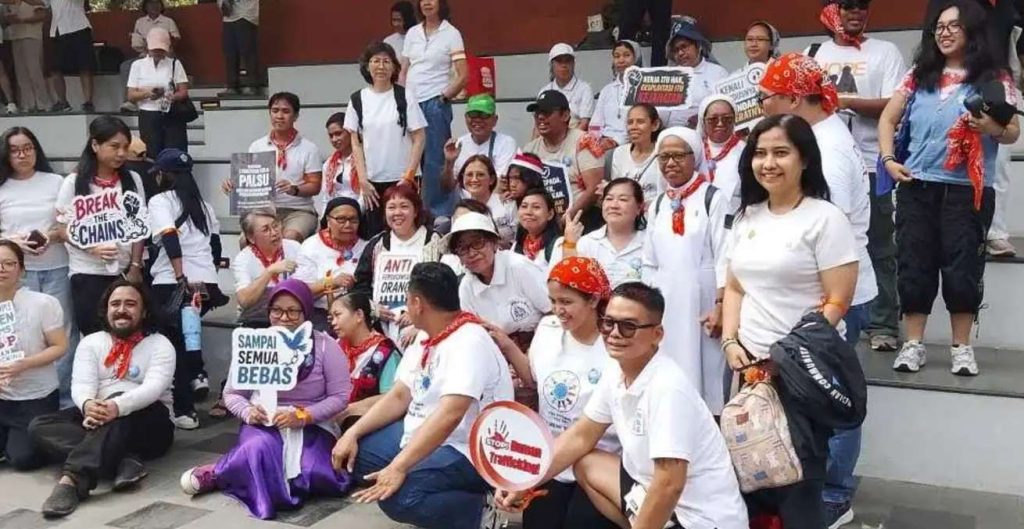
This demonstration carries genuine significance for the Church, and in this case, that significance is strongly encouraging. Catholic sisters choosing to march publicly through city streets represents a visible, embodied form of advocacy that goes well beyond written statements or private charitable work. It places Catholic social teaching on human dignity directly into public view, at a moment when this particular form of exploitation, hidden behind ordinary-looking online job postings, is easy for the wider public to underestimate or overlook entirely.
At the same time, an honest reading of this moment requires acknowledging the sheer scale of what these advocacy efforts are working against. Online scam operations tied to trafficking now generate tens of billions of dollars annually according to international monitoring bodies, and the criminal networks behind them are expanding into new regions as quickly as authorities can respond. Grassroots awareness campaigns, however courageous and well-organized, cannot single-handedly dismantle a transnational criminal industry of this size. Their real value lies in prevention, reaching people before deception occurs, and in walking alongside survivors afterward, work that remains essential even though it cannot solve the crisis alone.
The Meaning Behind the Name Talitha Kum
The name Talitha Kum carries deep spiritual significance that speaks directly to this mission. It comes from the Gospel of Mark, where Christ takes a dead girl by the hand and says, “Talitha koum,” Aramaic for “Little girl, get up,” restoring her to life before her astonished parents. The sisters who chose this name for their global anti-trafficking network were making a deliberate theological statement: their work is not simply rescue or awareness, but resurrection, calling survivors back to dignity, freedom, and new life after exploitation has tried to take those things away.
That image captures something essential about this ministry that statistics alone cannot convey. Every survivor accompanied by Talitha Kum’s network represents a small echo of that same Gospel moment, someone once trapped being helped back to their feet.
A Spiritual Resolution
Confronting an industry as vast and adaptable as online scam trafficking requires more than public demonstrations alone, however important those remain. Five ordinary practices provide the deeper spiritual foundation sustaining sisters and advocates in this work day after day.
- Confession, which clears away despair in the face of an overwhelming crisis, restoring the hope needed to keep showing up for prevention work that rarely produces immediate, visible results.
- Adoration, quiet time before Christ that renews the patience required for advocacy work measured in years, not headlines.
- The Rosary, a steady rhythm of prayer that can be offered specifically for trafficking survivors and for those still trapped in exploitation today.
- The Eucharist, received faithfully, sustaining sisters and advocates through work that is often emotionally demanding and slow to show results.
- Scripture, particularly Christ’s own command to “get up,” grounding this entire ministry in the conviction that restoration, not permanent loss, has the final word.
A Warning Worth Repeating
The nuns who marched through Jakarta ahead of World Day Against Trafficking in Persons were delivering a message that deserves far wider attention than a single demonstration can achieve on its own: online job offers, however convincing, can become pathways into exploitation, and roughly 10,000 Indonesians have already learned that the hard way since 2020. Talitha Kum’s ongoing work, grounded in a Gospel image of restoration rather than despair, offers both a warning and a genuine source of hope. Coverage of this story and the wider anti-trafficking effort, including from platforms such as EWTN Asia Pacific News, continues to help this warning reach communities who may not yet know how real this threat has become.
If this story moved you, share it with someone who might be evaluating an online job offer that sounds too good to be true, and consider keeping trafficking survivors and those still trapped in exploitation in your prayers.
To remain informed about Catholic life, teachings, and global Church developments, readers may be encouraged to visit www.ewtnvatican.com for trusted Catholic news and resources.