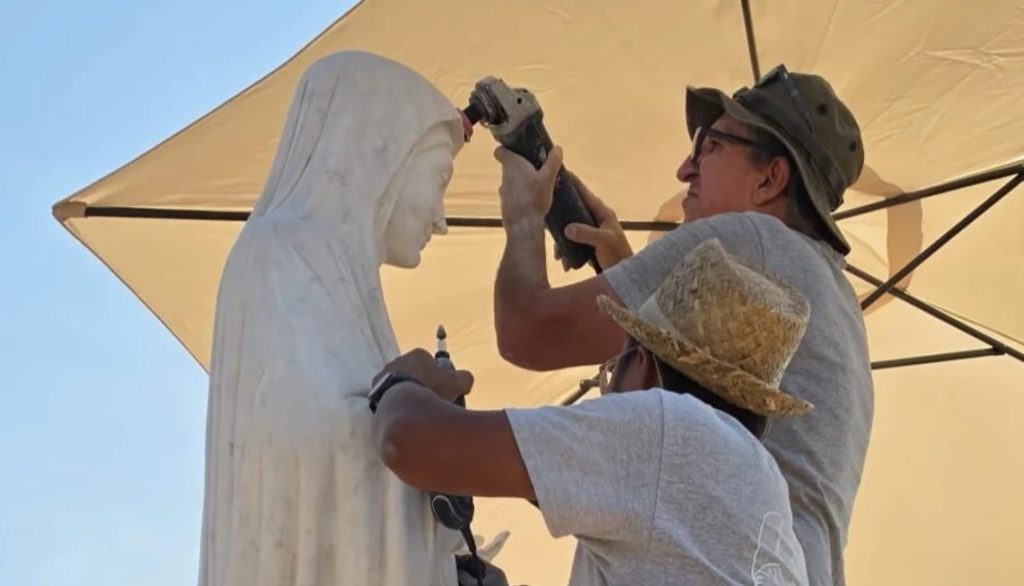
They covered Our Lady in black paint. They tried to scar one of the world’s most visited places of prayer. Within a day, the damage was gone, and the evening prayer program resumed exactly as scheduled. What happened at Medjugorje in the hours following last week’s vandalism attack has become, for many pilgrims, a more powerful story than the attack itself: a community that met desecration not with outrage, but with brushes, water, and an unshakable return to the Gospel.
From Vandalism to Restoration: How Medjugorje Responded Within Hours
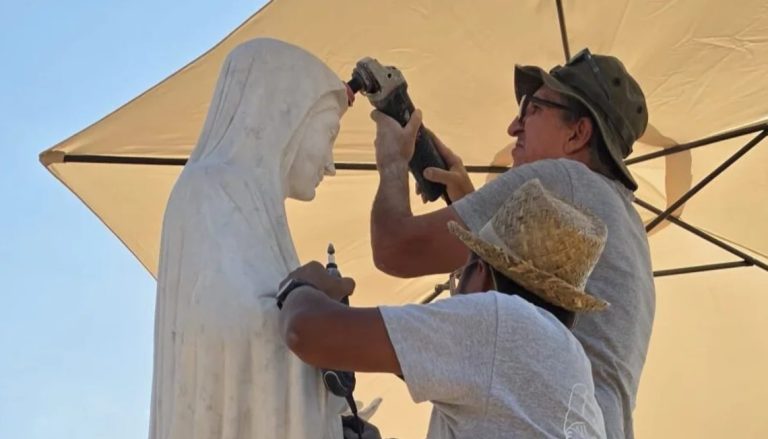
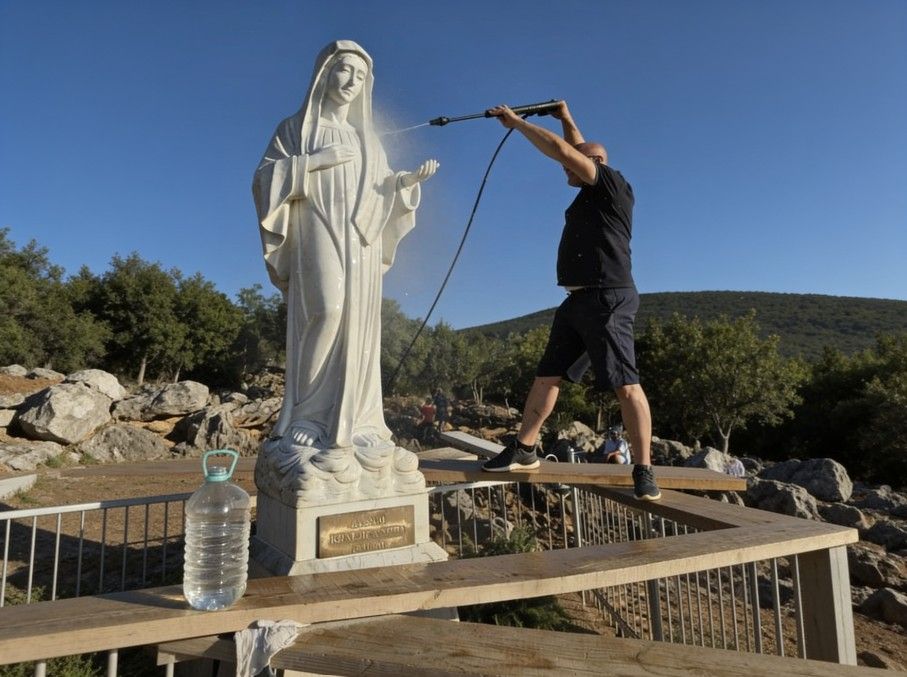
The overnight attack on July 28 left the statue of Our Lady, Queen of Peace, on Apparition Hill covered in black paint across its face, chest, and dress, with the words “Devil in a skirt” scrawled across its pedestal. A second statue near the nearby Blue Cross was similarly defaced, and the outdoor altar behind St. James Church was set ablaze before firefighters extinguished the flames. What followed happened remarkably fast. Members of the parish community, joined by the Cenacolo Community and a wave of local volunteers, moved immediately to clean the statues and repair the altar, working quickly enough that the shrine’s regular evening prayer program continued that same day, without interruption.
Once the restoration was complete, pilgrims and members of the Cenacolo Community gathered to kneel before the statue in thanksgiving, a quiet, spontaneous moment of gratitude that captured, perhaps better than any statement could, how the community chose to respond. The parish office later confirmed that all affected areas had been fully cleaned and restored, allowing Apparition Hill to once again serve its intended purpose: a place where pilgrims come to pray under what many describe as the loving gaze of the Queen of Peace.
The Suspect, the Charges, and an Unexpected Call for Compassion
Bosnian police moved quickly as well. A 31-year-old Polish national, identified in local reporting as Bartłomiej Włodzimierz Krakowiak, was arrested in the nearby village of Cerno nearby Ljubuški shortly after the attack. He faces charges of damaging or destroying religious property under Bosnian law, an offense carrying a potential sentence of six months to five years, with state prosecutors now handling the case as investigators work to determine his motive and whether he was responsible for the additional graffiti reported at other pilgrimage sites that same night.
What has struck many observers most, however, is how quickly voices within the Church moved to protect the suspect himself from a very different kind of harm. A Polish priest speaking to Catholic radio urged the faithful to remember that while damaged religious objects can be repaired, something far more important was at stake: the eternal life of the man responsible. That sentiment echoed the parish’s own public statement, which explicitly asked for prayers for the conversion of whoever committed the act, rather than public condemnation or online harassment directed at him personally.
Why This Response Is Significant for the Church Today
This update carries real significance for the Church, and in this case, the significance is strongly encouraging. A community’s ability to fully restore a desecrated sacred site within a single day, while simultaneously calling for compassion toward the person responsible, offers a rare and credible public witness at a moment when outrage often spreads faster than grace online. This kind of response cannot be manufactured for public relations; it reflects decades of formation around Medjugorje’s own consistent message of prayer, fasting, and forgiveness, put into practice under real pressure rather than simply preached about.
A Message Older Than the Vandalism Itself
For more than forty years, the message associated with Medjugorje has remained remarkably consistent: pray, fast, forgive, and choose peace. What makes this restoration story spiritually significant is not simply that the statue was cleaned, but that the community’s response embodied that exact message under real duress, choosing mercy over anger and prayer for conversion over condemnation. Evil may deface a statue, but it cannot erase what the statue represents, and fire may scorch stone, but it cannot consume hope built on forty years of consistent spiritual practice.
Spiritual Resolution
The physical restoration completed within a single day is remarkable, but the deeper restoration Medjugorje’s message has always pointed toward is one that takes far longer and asks far more of the human heart. Five enduring practices, already woven into the shrine’s daily rhythm of prayer, offer the real framework behind a response like this one.
- Confession, offered regularly at Medjugorje and central to its message for over four decades, is what makes praying for an offender’s conversion, rather than his punishment, possible in the first place.
- Adoration, the quiet posture of resting before Christ, is what steadies a community enough to choose restoration over retaliation in the hours after an attack.
- The Rosary, prayed daily at the shrine and central to Our Lady’s own message there, roots the parish’s response in decades of consistent devotion rather than a single reactive moment.
- The Eucharist, celebrated without interruption even on the evening of the attack, remained the unshaken center around which the entire community continued to gather.
- Scripture, particularly Christ’s own call to forgive those who cause harm, is the foundation beneath the parish’s explicit prayer for the conversion of the person responsible.
This is the victory Medjugorje’s message has always pointed toward, one measured not in restored paint or repaired stone, but in love proving stronger than hatred, forgiveness outlasting vengeance, and hope refusing to yield to despair. Coverage of this update, including from platforms such as EWTN Asia Pacific News, continues to follow the story as investigators complete their work and Medjugorje prepares to welcome the pilgrims still to come.
To remain informed about Catholic life, teachings, and global Church developments, readers may be encouraged to visit www.ewtnvatican.com for trusted Catholic news and resources.