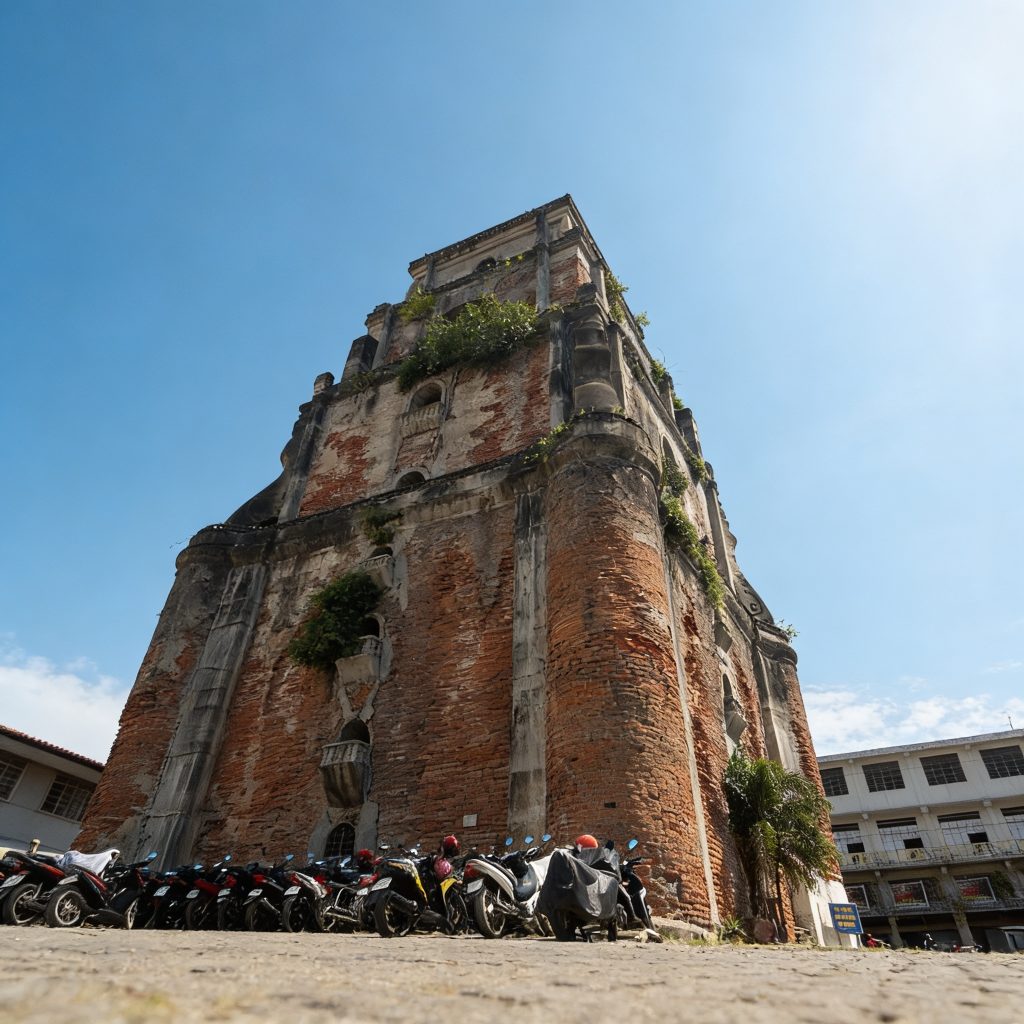
A Tower That Sinks Yet Stands Strong
Imagine a structure so heavy that it slowly sinks into the earth beneath it, yet continues to stand tall as a beacon of faith for centuries. This is the reality of the Laoag sinking bell tower in Ilocos Norte, Philippines—a centuries-old architectural marvel that defies conventional engineering wisdom while inspiring profound spiritual reflection.
Every year, this magnificent belfry descends approximately one inch into the sandy soil of Laoag City. At this rate, one might expect the tower to have already disappeared into the ground. Yet, standing at 45 meters tall with a foundation spanning 90 meters, the Laoag sinking bell tower remains one of the most iconic and visited heritage sites in the Philippines.
But what makes this structure truly remarkable is not merely its physical persistence. Rather, it is what the Laoag sinking bell tower represents to the faithful who visit it—a powerful symbol of enduring spiritual strength, resilience through trials, and the unwavering foundation of Catholic faith that has sustained the Ilocano people for over four centuries.
This article explores five faithful secrets of the Laoag sinking bell tower that reveal why this unique landmark continues to captivate pilgrims, historians, and believers from across the Asia Pacific region. These secrets span architecture, history, spirituality, and community—offering insights that extend far beyond the physical structure itself.
Secret #1: The Mystery of Why the Laoag Sinking Bell Tower Descends
The most frequently asked question about this remarkable structure is simple yet profound: Why is the Laoag sinking bell tower sinking?
The answer lies in a combination of geological and architectural factors that have puzzled engineers and historians for generations. The tower was built on sandy soil, which naturally compacts and shifts over time. When you combine this unstable foundation with the extraordinary weight of the structure—constructed entirely of locally manufactured bricks bound together with mortar—the slow descent becomes inevitable.
However, this is not a catastrophic collapse. Rather, it is a gradual, measurable process. The Laoag sinking bell tower descends at a rate of approximately one inch per year, a phenomenon that has been documented and studied by structural engineers and heritage preservation experts.
This phenomenon has fascinated scholars and visitors alike for centuries. The Laoag sinking bell tower sinks evenly and predictably, a testament to the careful engineering and construction methods employed by its builders.
The geological composition beneath the Laoag sinking bell tower is primarily sandy soil mixed with clay deposits. This type of soil is particularly susceptible to compaction under heavy structures. The tower remains perfectly vertical and structurally sound, a testament to exceptional engineering principles.
Understanding the Foundation’s Role
The foundation of the Laoag sinking bell tower is constructed with four massive columns positioned at each corner, designed to distribute the enormous weight of the structure across the sandy terrain. These columns, reinforced with a winding stairway and internal support systems, were built by skilled Ilocano artisans who understood the challenges of constructing permanent structures in their region.
Despite these engineering considerations, the natural compaction of sand beneath the foundation ensures that the Laoag sinking bell tower will continue its slow descent. Yet this descent has not compromised the structural integrity of the tower itself. The bricks remain firmly bound, the columns stand resolute, and the tower continues to serve its spiritual and historical purpose.
The four corner columns act as load-bearing pillars that distribute the weight of the 45-meter structure across a wide base. This design prevents the tower from sinking unevenly or developing structural cracks.
Each column is constructed from the same locally manufactured bricks used throughout the tower, bound together with the special mortar recipe. This consistency in materials ensures that the foundation settles uniformly with the rest of the structure.
A Living Testament to Time
What makes the Laoag sinking bell tower unique is that its descent is not a sign of failure—it is a sign of authenticity. This tower has not been artificially stabilized or reconstructed. It remains in its original form, slowly returning to the earth from which its materials were drawn.
For believers, this gradual descent carries profound spiritual meaning. It reminds us that all earthly structures are temporary, that time itself is a gift from God, and that true permanence lies not in physical buildings but in the faith they house and the community they serve.
In earlier centuries, visitors on horseback could ride through the entrance tunnel without bending. Today, an average adult must stoop to enter. This visible evidence of the Laoag sinking bell tower’s descent provides a tangible connection to the passage of time and the inevitability of change.
This physical transformation serves as a powerful reminder of the passage of time. Each generation experiences the tower differently as its relationship to the ground changes. This mirrors the spiritual journey of humility and submission that the tower invites from those who visit it.
Secret #2: The Sacred Construction Technique Behind the Laoag Sinking Bell Tower
The second faithful secret of the Laoag sinking bell tower lies in how it was built—a construction method that combines indigenous knowledge, Spanish colonial engineering, and deep spiritual purpose.
The Unique Mortar Recipe
The Laoag sinking bell tower was constructed using locally manufactured bricks joined together with a mortar unlike any other used in colonial architecture. This mortar was created by mixing sand, lime, and molasses with the juice of sablot leaves—a native plant known for its binding properties.
This recipe was not accidental. The Augustinian friars who oversaw the construction understood that the tropical climate of Ilocos Norte required materials that could withstand intense heat, humidity, and occasional seismic activity. The addition of molasses and sablot leaf juice created a mortar that was both flexible and durable, allowing the structure to shift slightly during earthquakes without cracking.
The use of molasses in the mortar is particularly significant. Molasses, a byproduct of sugar processing, was readily available in the region and possessed binding properties that enhanced the durability of the mortar. The sablot leaf juice added additional flexibility to the mortar, allowing it to accommodate the slight movements caused by settling soil and seismic activity. This combination created a mortar that was superior to the rigid lime-based mortars used in purely European construction methods. The mortar recipe represents a brilliant example of indigenous knowledge integrated with Spanish colonial engineering.
The Craftsmanship of Ilocano Artisans
The Laoag sinking bell tower stands as a testament to the extraordinary craftsmanship of Ilocano artisans. These skilled workers, under the guidance of Augustinian friars, created a structure that has endured for over three centuries. Their understanding of local materials, climate conditions, and the spiritual significance of their work infused every brick and every joint with purpose.
The construction of the Laoag sinking bell tower was not merely a practical project—it was a spiritual undertaking. The artisans who built it understood that they were creating a structure that would call the faithful to prayer, mark the passage of time, and serve as a permanent witness to the presence of God in their community.
The bricks used in the Laoag sinking bell tower were manufactured locally, using clay from the surrounding region. The mortar that binds these bricks together represents the fusion of Spanish colonial knowledge with indigenous Ilocano wisdom, creating a hybrid construction technique that proved superior to purely European methods.
The artisans who built the Laoag sinking bell tower worked with remarkable precision and care. Each brick was carefully placed and aligned. Each joint was filled with the special mortar recipe, ensuring that the structure would be both strong and flexible. These artisans understood they were creating a permanent witness to the faith of their people.
The construction of the Laoag sinking bell tower took many years to complete. The artisans who worked on this project did so with the knowledge that they might not live to see the finished structure. Yet they labored faithfully, knowing that their work would serve generations of believers yet unborn. This spirit of sacrifice and dedication, infused into every brick and every joint, is perhaps the most important element of the tower’s construction.
The Four Massive Columns
At each corner of the Laoag sinking bell tower stand four massive columns that serve as the primary support system. These columns were designed to distribute the enormous weight of the structure evenly across the sandy foundation. The engineering principle behind this design demonstrates that the builders understood load distribution and structural stability—concepts that would not be formally codified in engineering textbooks for centuries to come.
Each of the four columns measures several meters in diameter and extends deep into the sandy soil below. The spacing and positioning of these columns were calculated with remarkable precision, ensuring that the weight of the tower is distributed evenly and that no single point bears excessive stress.
Secret #3: The Laoag Sinking Bell Tower as an Earthquake Baroque Masterpiece
The third faithful secret reveals why the Laoag sinking bell tower has survived multiple earthquakes despite its gradual descent into the earth. The answer lies in its architectural classification as an “Earthquake Baroque” structure.
What is Earthquake Baroque Architecture?
Earthquake Baroque is a unique architectural style that emerged in the Philippines during the Spanish colonial period. This style represents an adaptive response to the region’s seismic activity. Rather than building rigid structures that would shatter during earthquakes, architects designed buildings with flexibility and resilience in mind.
The Laoag sinking bell tower exemplifies this philosophy. Its design incorporates features that allow the structure to shift and flex during seismic events without catastrophic failure. The massive columns, the flexible mortar, and the overall weight distribution all contribute to the tower’s remarkable ability to withstand earthquakes.
Earthquake Baroque architecture represents a brilliant synthesis of European architectural traditions and practical knowledge. The builders of the Laoag sinking bell tower understood that rigidity leads to failure in earthquake-prone areas. Instead, they created a structure that could move with the earth, absorbing seismic energy rather than resisting it.
The Philippines, located in the Pacific Ring of Fire, experiences frequent seismic activity. The Earthquake Baroque style emerged as a direct response to this geological reality. Churches and bell towers built in this style featured thicker walls, wider bases, and flexible mortar joints that allowed the structure to move without cracking.
Surviving the 1983 Earthquake
In 1983, a powerful 7.8 magnitude earthquake struck the Ilocos Region, causing significant damage to many structures throughout Ilocos Norte. Yet the Laoag sinking bell tower remained standing. While other buildings crumbled, this ancient belfry demonstrated the wisdom of its builders and the effectiveness of Earthquake Baroque design principles.
This survival was not coincidental. It was the direct result of construction methods that prioritized flexibility over rigidity, and resilience over perfection. The Laoag sinking bell tower bends with the earth’s movement rather than resisting it—a principle that modern seismic engineers have only recently begun to fully appreciate and implement.
Seismic engineers who studied the tower’s response to this powerful tremor discovered that the structure had shifted and flexed during the earthquake, absorbing the seismic energy without sustaining significant damage. The flexible mortar had allowed individual bricks to move slightly relative to one another, dissipating the force of the earthquake rather than allowing it to accumulate and cause catastrophic failure.
The Separate Tower Design
One critical design feature that contributed to the Laoag sinking bell tower’s survival is its location. The tower stands approximately 80 meters away from St. William’s Cathedral itself. This separation was intentional and strategic.
By building the bell tower at a distance from the main cathedral, the architects ensured that if the tower were to collapse during an earthquake, it would not damage the church. This design prioritized the protection of the sacred space where the Eucharist is housed and where the faithful gather for Mass. The Laoag sinking bell tower, in a sense, sacrifices itself to protect the cathedral—a physical manifestation of the spiritual principle of self-giving love.
The distance of 80 meters provides a substantial buffer zone that would prevent the tower from collapsing onto the cathedral in even the most severe seismic event. This design choice reflects the builders’ understanding that the cathedral must be protected at all costs.
This separation also serves a practical acoustic function. The bells can be heard throughout the city without overwhelming those worshipping in the cathedral. This thoughtful design demonstrates that the builders considered both structural integrity and the spiritual needs of the community.
Secret #4: The Historical Witness of the Laoag Sinking Bell Tower
The fourth faithful secret of the Laoag sinking bell tower lies in its role as a historical witness to pivotal moments in Philippine history. This structure has not merely stood passively through the centuries—it has actively participated in the life of the nation.
The Laoag sinking bell tower has been present during significant moments in Philippine history. From Spanish colonial rule through independence and modernization, this structure has endured and adapted. It has been a symbol of continuity and stability during times of great change.
A Watchtower During the Philippine Revolution
In 1898, during the Philippine Revolution against Spanish colonial rule, the Laoag sinking bell tower served as an observation post for Filipino revolutionaries. From its height of 45 meters, fighters could survey the surrounding landscape and coordinate their movements against Spanish forces.
This historical role demonstrates that the Laoag sinking bell tower has always been more than a religious structure. It has been a community resource, a symbol of collective identity, and a tool for the pursuit of freedom and justice.
The revolutionaries who used the Laoag sinking bell tower understood its strategic value. From the top of the tower, observers could see for miles across the flat terrain of Ilocos Norte, providing early warning of Spanish military movements.
A Vantage Point During World War II
Decades later, during World War II, the Laoag sinking bell tower again served a strategic purpose. Filipino guerrillas used the tower as a vantage point to observe Japanese military movements and coordinate resistance efforts. Once again, this ancient structure found itself at the center of historical events that would shape the destiny of the Philippine nation.
The Bells That Marked Community Life
Throughout its history, the bells of the Laoag sinking bell tower have rung out across Laoag City, marking the passage of time and calling the faithful to prayer. These bells have announced births, celebrated marriages, mourned deaths, and summoned the community to worship.
Historical accounts reveal that the ringing of the bells was not merely ceremonial. The volume and frequency of the bell ringing conveyed social information. Weddings of prominent families were announced with louder and more frequent ringing than weddings of poorer families—a practice that reflected the social hierarchies of the time, yet also demonstrated how the Laoag sinking bell tower was woven into the fabric of community life.
The bells of the Laoag sinking bell tower served as the community’s primary means of communication. Different bell patterns conveyed different messages—a slow, mournful tolling announced a death, while rapid, joyful ringing celebrated a wedding or feast day. The bells marked the time of day for the community and summoned the faithful to prayer.
The bell tower’s bells have been rung for over three centuries, creating a continuous thread of sound that connects the present to the past. For the people of Laoag, the sound of the bells is the voice of their city and a connection to their ancestors and descendants.
Secret #5: The Spiritual Significance of the Laoag Sinking Bell Tower for Modern Believers
The fifth and most profound faithful secret of the Laoag sinking bell tower concerns its spiritual meaning for contemporary believers. This secret transcends architecture and history, touching the deepest yearnings of the human heart.
A Symbol of Enduring Faith
For pilgrims and believers, the Laoag sinking bell tower represents faith that endures despite challenges. The tower sinks, yet it stands. It ages, yet it remains. It has survived earthquakes, wars, and the passage of centuries, yet it continues to call the faithful to prayer.
This physical reality mirrors the spiritual journey of every believer. Our faith is tested by trials, pressures, and the weight of earthly concerns. Yet, like the Laoag sinking bell tower, authentic faith does not collapse under pressure—it deepens, it strengthens, and it continues to point toward heaven.
The Laoag sinking bell tower teaches us that endurance involves accepting change while maintaining our essential purpose. The tower changes—it sinks, it ages, it weathers—yet it remains fundamentally itself. Similarly, our faith must be flexible enough to adapt to changing circumstances, yet firm enough to maintain its core commitment to Christ and His Church.
The Paradox of Strength Through Weakness
The Laoag sinking bell tower embodies a paradox that lies at the heart of Christian spirituality: true strength is found through apparent weakness. The tower does not resist its descent into the earth. Rather, it accepts this process while maintaining its structural integrity and spiritual purpose.
This teaches us that spiritual strength is not about resisting all challenges or maintaining perfect control. Rather, it is about accepting our limitations, trusting in God’s providence, and continuing to serve our purpose even as we grow older and face new difficulties.
Saint Paul wrote: “When I am weak, then I am strong” (2 Corinthians 12:10). The Laoag sinking bell tower embodies this paradox. Its weakness becomes its strength. The tower’s acceptance of its own mortality makes it a more powerful witness to the eternal nature of God’s love.
A Call to Pilgrimage and Prayer
For many believers, visiting the Laoag sinking bell tower is a pilgrimage—a spiritual journey undertaken with intention and reverence. Pilgrims come to this sacred site to pray, to reflect, and to encounter the presence of God in a place where faith has been witnessed and proclaimed for over four centuries.
The Laoag sinking bell tower invites us to consider our own spiritual pilgrimage. Are we moving toward God, or away from Him? Are we sinking into despair, or ascending toward hope? Are we allowing our faith to deepen and mature, or are we resisting the transformative work of the Holy Spirit in our lives?
Pilgrimage is a spiritual practice that opens our hearts to encounter the divine. When we visit the Laoag sinking bell tower, we are participating in a tradition of faith that stretches back centuries. We are joining our prayers with the prayers of countless believers who have stood before this tower.
The Community of Faith
The Laoag sinking bell tower has always belonged to a community. It was built by a community of artisans, it has served a community of believers, and it continues to be cherished by a community of pilgrims and heritage advocates.
This reminds us that faith is not a solitary endeavor. We are called to belong to the Church, to participate in the sacramental life of the parish, and to support one another in our spiritual journey. The Laoag sinking bell tower stands as a physical reminder of this communal dimension of faith.
The parish community of Laoag has maintained a deep connection to the bell tower for centuries. Through periods of Spanish colonial rule, Philippine independence, world wars, and modernization, the community has continued to gather at St. William’s Cathedral and to hear the bells of the Laoag sinking bell tower calling them to prayer. This continuity of faith, maintained by successive generations of believers, is perhaps the most remarkable aspect of the tower’s history.
Today, the Laoag sinking bell tower continues to draw pilgrims and visitors from around the world. These visitors come not merely to observe an architectural curiosity, but to encounter a place where faith has been lived and witnessed for over four centuries. They come to pray, to reflect, and to connect with the long tradition of Catholic faith that the tower represents.
The tower teaches us that our faith is communal. We receive faith from those who came before us and pass it on to those who come after us. The Laoag sinking bell tower is a tangible expression of this intergenerational transmission of faith.
Visiting the Laoag Sinking Bell Tower: Practical Information
For those inspired to visit this remarkable heritage site, here is essential information to enhance your pilgrimage experience.
Location and Accessibility
The Laoag sinking bell tower is located in Laoag City, Ilocos Norte, approximately 80 meters from St. William’s Cathedral. The site is easily accessible from the city center. Laoag City is served by an airport with connections to Manila and other major Philippine cities.
Best Times to Visit
The tower can be visited year-round, though the dry season (November through April) offers the most comfortable weather. During Holy Week, the site attracts particularly large numbers of pilgrims engaged in the traditional Visita Iglesia practice. The feast day of St. William (August 10) is also a significant occasion for pilgrimage.
Respectful Visitation Guidelines
While the exterior of the Laoag sinking bell tower can be freely observed and photographed, unauthorized entry into the tower itself is strictly prohibited by city ordinance. Visitors are encouraged to maintain a reverent demeanor and to respect the sacred nature of the space.
Photography and Contemplation
The Laoag sinking bell tower is particularly photogenic during early morning and late afternoon hours. However, visitors are encouraged to balance photography with quiet contemplation and prayer.
The Laoag Sinking Bell Tower and Heritage Preservation
The preservation of the Laoag sinking bell tower is an ongoing commitment that involves multiple stakeholders, including local government units, the Diocese of Laoag, heritage preservation organizations, and the broader community.
Current Restoration Efforts
The National Historical Commission of the Philippines (NHCP) has been involved in monitoring and maintaining the structural integrity of the Laoag sinking bell tower. The Diocese of Laoag has also been instrumental in the preservation and promotion of the Laoag sinking bell tower, recognizing its spiritual and cultural significance.
The Role of Community Stewardship
The preservation of the Laoag sinking bell tower depends on the commitment of the local community and visitors to treat this site with respect and reverence. Every pilgrimage, every prayer, and every act of stewardship contributes to the ongoing preservation of this sacred structure. The people of Laoag City take great pride in their heritage and in the Laoag sinking bell tower as a symbol of their faith and identity.
Connecting the Laoag Sinking Bell Tower to Your Spiritual Journey
The Laoag sinking bell tower offers profound lessons that extend far beyond its physical structure. It invites us to reflect on our own spiritual journey and to deepen our commitment to the Catholic faith.
The Call to Confession
Just as the Laoag sinking bell tower gradually descends into the earth, our souls can gradually drift away from God through sin and spiritual negligence. The Sacrament of Confession offers us the opportunity to halt this spiritual descent and to restore our relationship with God. The bells of the Laoag sinking bell tower have called the faithful to confession for centuries. In confession, we experience the mercy of God and the restoration of our souls.
The Invitation to Eucharistic Adoration
The Laoag sinking bell tower stands near St. William’s Cathedral, where the Blessed Sacrament is reserved. This proximity invites us to spend time in Eucharistic Adoration—quiet hours spent in the presence of Jesus in the Blessed Sacrament. In adoration, we encounter Christ directly and allow His presence to transform us and to deepen our faith.
The Practice of the Holy Rosary
The Rosary is a powerful prayer that has sustained Catholic faith through centuries of change and challenge. Praying the Rosary at or near the Laoag sinking bell tower connects us to the long tradition of Marian devotion that has characterized Filipino Catholicism. The Rosary invites us to meditate on the mysteries of Christ’s life, death, and resurrection.
Active Participation in the Holy Mass
The ultimate expression of Catholic faith is active participation in the Holy Mass. The Laoag sinking bell tower has called the faithful to Mass for over four centuries. When we participate in the Mass, we join with the universal Church in offering worship to God and we are transformed by the sacred encounter with Christ.
Reflection on Sacred Scripture
The Laoag sinking bell tower was built by people who understood Scripture deeply. They knew the words of Jesus: “Unless a grain of wheat falls to the ground and dies, it remains alone; but if it dies, it produces much fruit” (John 12:24). The tower’s gradual descent into the earth mirrors this spiritual principle. We are invited to reflect daily on Sacred Scripture, allowing God’s Word to transform our hearts and minds.
Understanding the Laoag Sinking Bell Tower’s Relevance Today
In our modern world of rapid technological change and social upheaval, the Laoag sinking bell tower offers a powerful message of stability and endurance. This ancient structure continues to stand, calling the faithful to prayer and reminding us of the eternal nature of God’s love.
The tower’s slow descent into the earth is a metaphor for the spiritual journey that each believer undertakes. We are called to let go of our attachment to worldly things, to accept our limitations, and to trust in God’s providence. The Laoag sinking bell tower teaches us that this process of letting go is not a tragedy—it is a grace.
For believers in the Asia Pacific region, the Laoag sinking bell tower represents a living connection to centuries of Catholic faith and practice. It reminds us that we are part of a global Church with deep historical roots, and that our faith is ancient, resilient, and proven through centuries of trials and challenges.
The Enduring Message of the Laoag Sinking Bell Tower
The Laoag sinking bell tower stands as more than a historical monument or architectural curiosity. It is a profound spiritual teacher, inviting us to reflect on faith, resilience, and the eternal nature of God’s love.
This remarkable structure descends slowly into the earth, yet it continues to stand tall. It has survived earthquakes, wars, and the passage of centuries. It has witnessed the joys and sorrows of countless generations. And it continues to call the faithful to prayer, to worship, and to deeper commitment to Christ.
The five faithful secrets of the Laoag sinking bell tower—its mysterious descent, its sacred construction, its earthquake-resistant design, its historical witness, and its spiritual significance—all point toward a single truth: that authentic faith endures through all trials and challenges.
As you reflect on the lessons of the Laoag sinking bell tower, consider how these truths apply to your own spiritual journey. Are you willing to accept your limitations while maintaining your spiritual purpose? Are you committed to deepening your faith even as the world around you changes?
The Laoag sinking bell tower invites you to a deeper encounter with Christ. It calls you to approach the Sacrament of Confession with honesty and humility. It invites you to spend quiet hours in Eucharistic Adoration, encountering Jesus in the Blessed Sacrament. It encourages you to pray the Holy Rosary with devotion and intention.
Most importantly, it calls you to active participation in the Holy Mass—the source and summit of Christian life—where you receive the Eucharist and are transformed by the presence of Christ. And it invites you to spend time daily with Sacred Scripture, allowing God’s Word to guide your steps and transform your heart.
The Laoag sinking bell tower has stood for over four centuries as a witness to these truths. Its patient descent into the earth is not a sign of failure, but a sign of authentic faith—faith that endures, faith that deepens, and faith that continues to point toward heaven.
Visit this sacred site. Pray before it. Allow its message to transform your heart. And join the countless believers across the centuries who have found in the Laoag sinking bell tower a powerful reminder that God’s love, like this ancient structure, endures forever.
For more information about Catholic faith, heritage preservation, and spiritual resources, visit EWTN Vatican to deepen your understanding of the Church’s teachings and to stay connected with the global Catholic community.