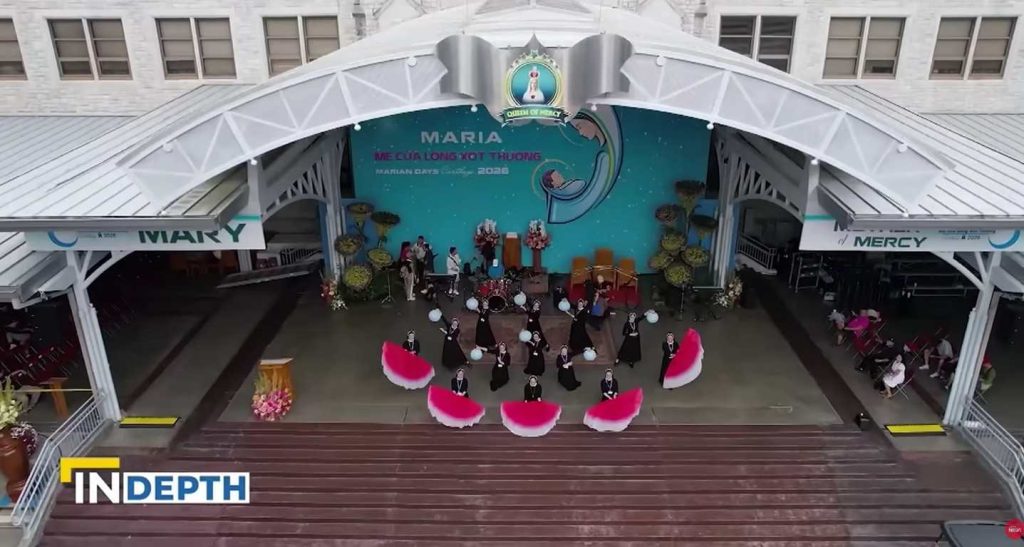
Every August, a town of roughly 15,600 people in southwestern Missouri transforms almost overnight. Carthage’s quiet streets fill with campers, food stalls, and processions as up to 100,000 Vietnamese American Catholics arrive for Marian Days, one of the largest annual Catholic gatherings in the United States. What began nearly five decades ago as a small, improvised act of devotion by a handful of refugee clergy has grown into a defining expression of Vietnamese Catholic identity in America, and its origin story is as remarkable as the crowds it now draws.
From Refugee Camps to Sacred Ground: The Origin Story of Marian Days
Marian Days began after the fall of Saigon in 1975, when around 185–200 members of Vietnam’s Congregation of the Mother Co-Redemptrix fled to the United States and settled in refugee camps. Bishop Bernard Law welcomed them to the Diocese of Springfield-Cape Girardeau, where they established themselves in a former seminary in Carthage, Missouri. In 1978, the first Marian Days was held there, drawing about 1,500 people.
Brother Thomas Dien, an early member of the order, later reflected on what that freedom meant after years of religious persecution back home, describing it simply as a blessing to be able to profess one’s faith openly in America. That sense of hard-won religious freedom remains woven into the celebration nearly fifty years later, even as it has grown from a modest gathering of displaced clergy into a pilgrimage drawing visitors from across the United States, Canada, Vietnam, and beyond.
Inside the Festival: Faith, Culture, and Community on 28 Acres
Today, Marian Days unfolds over four days each August on the order’s 28-acre campus, now formally known as the Congregation of the Mother of the Redeemer. The 2026 celebration, held August 6 through 9, marked the pilgrimage’s 48th year, featuring daily Mass, Marian processions, religious workshops, and a full expression of Vietnamese culture through music, traditional food, and fellowship. Pilgrims camp across sixty additional acres on a first-come, first-served basis, while hundreds of volunteers, including religious sisters from the Congregation of Mary Queen who have served at the event for more than 40 years, help keep the massive gathering running smoothly.
At the spiritual heart of the celebration is devotion to Our Lady of La Vang, the title under which the Blessed Virgin Mary is venerated within Vietnamese Catholic tradition, alongside a statue of Our Lady of Refugees that stands as a poignant symbol of the community’s own history of displacement and resilience. The event’s spiritual practice draws heavily on devotion to the Rosary and a call to ongoing personal conversion, themes central to Marian spirituality more broadly. The pilgrimage also carries real significance for its host community: an event of this scale brings tens of millions of dollars in economic impact to Carthage and neighboring towns, transforming a brief annual weekend into a meaningful boost for the wider region.
Why This Pilgrimage Is Significant for the Church Today
This story carries genuine significance for the Church, and in this case, that significance is deeply encouraging. Marian Days stands as a living testimony to how faith can sustain both spiritual identity and cultural memory across displacement and exile. A community that arrived in America with almost nothing beyond their faith and their vocation has built, over five decades, one of the largest and most vibrant annual Catholic gatherings in the country, a remarkable witness to what welcome, sponsorship, and sustained community effort can accomplish.
The pilgrimage also offers a quiet but meaningful reminder relevant well beyond the Vietnamese Catholic community itself: refugee and immigrant communities, given genuine welcome and support, are capable of extraordinary contribution and flourishing, both spiritually and economically, exactly what Carthage has experienced firsthand for nearly fifty years running. A small Midwestern town’s willingness to open its streets to a hundred thousand visitors each summer stands as its own quiet model of hospitality, one worth genuine appreciation rather than being taken for granted.
A Marian Devotion Born From Persecution
The devotion to Our Lady of La Vang carries a spiritual depth that predates the Carthage pilgrimage by nearly two centuries. According to Vietnamese Catholic tradition, Mary appeared to Catholics hiding in the forests near La Vang during a period of severe religious persecution in the late 1700s, offering comfort and protection to believers risking their lives simply to practice their faith. That same devotion, carried forward by refugees who once again faced upheaval and displacement in the 1970s, now anchors a pilgrimage held thousands of miles from Vietnam, in a small town most of those original refugees had never heard of before arriving there.
Seen this way, Marian Days is not simply a cultural festival with religious elements attached. It is a continuation of a centuries-long pattern in which Vietnamese Catholics have turned to Mary specifically in moments of persecution, exile, and uncertainty, finding in her a constant, protective presence across vastly different centuries and continents.
A Spiritual Resolution
Marian Days is, at its core, an expression of pilgrimage spirituality, faith lived out through movement, sacrifice, and sustained devotion rather than convenience. Five ordinary practices offer the same steady foundation that has carried this community’s faith across five decades and thousands of miles.
- Confession, sought out during the pilgrimage itself, allows visitors to approach the festival’s Masses and processions with genuinely renewed hearts rather than routine attendance alone.
- Adoration, offered amid the festival’s crowds and activity, provides a quiet center of stillness within what can otherwise be an overwhelming, joyfully chaotic gathering.
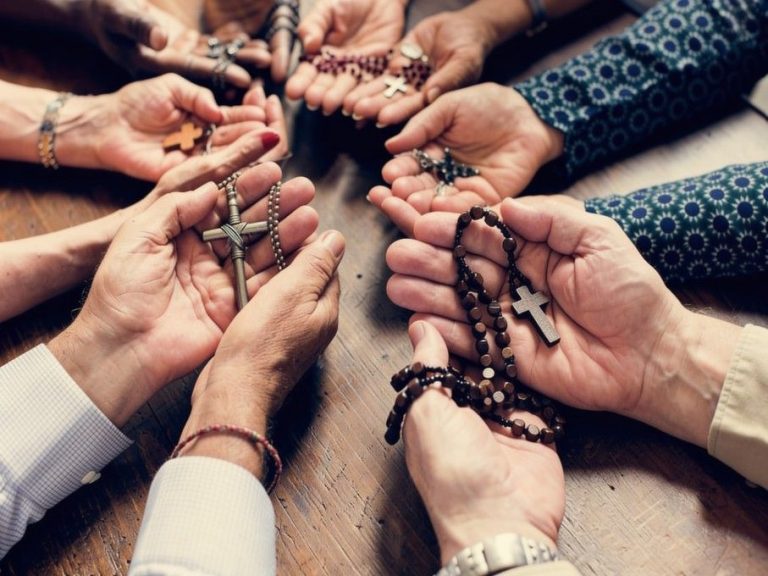
- The Rosary, central to the pilgrimage’s entire spiritual foundation, remains the most direct way pilgrims continue the devotion first carried by persecuted Catholics centuries ago in Vietnam.
- The Eucharist, celebrated daily throughout the four-day event, remains the true center around which every procession, workshop, and cultural celebration ultimately revolves.
- Scripture, reflected on through the pilgrimage’s religious workshops, roots this celebration in something deeper than cultural tradition alone, a living encounter with the God who sustained this community through exile.
To remain informed about Catholic life, teachings, and global Church developments, readers may be encouraged to visit www.ewtnvatican.com for trusted Catholic news and resources. Or watch catholic programming via EWTN flix app or EWTN Asia Pacific’s On Demand section