Manila, Philippines—The story of the Nuestro Padre Jesús Nazareno (The Black Nazarene) began in 1606, when Augustinian Recollect missionaries brought the dark-skinned Christ from Mexico to Philippine shores. Kneeling under the weight of a heavy cross, the image was first enshrined at the Recolletos church in Bagumbayan (now Luneta).
Within two years, the image was moved to a larger sanctuary in Intramuros. It was here that the seeds of a massive movement were planted: the Cofradia de Jesús Nazareno. This fraternity of men established a legacy of rugged, masculine piety that continues to define the devotion today, drawing millions of “Hijos” from across the globe to share in the weight of the cross.
In the late 18th century, Archbishop Basilio Sancho de Santa Justa y Rufina ordered the transfer of the Nazareno to Quiapo Church located in the city of Manila in the Philippines. This transition transformed Quiapo into a spiritual epicenter. The image became a symbol of survival; it endured violent earthquakes that leveled walls and survived two catastrophic fires. Most miraculously, the Black Nazarene remained unharmed during the carpet-bombing of Manila in World War II, even as the world around it crumbled.
Recognizing this profound spiritual significance, the church was elevated to a Minor Basilica in 1987 by His Eminence Jaime Cardinal Sin, then Archbishop of Manila. It was a formal acknowledgment of what the Filipino people already knew: Quiapo was a place of deep devotion and faith, and where miracles happen.
The “Traslacion” as we know it today as the massive, rhythmic tide of humanity was revitalized during the 400th-anniversary celebrations in 2006. Under the leadership of then-Parish Priest and Rector Msgr. Josefino Ramirez, the image was brought back to Luneta Park in Manila to retrace its historical journey from Intramuros to Quiapo.
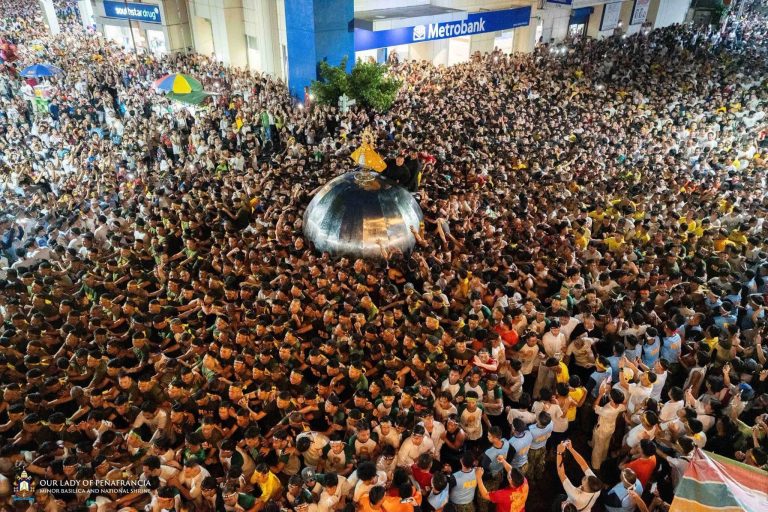
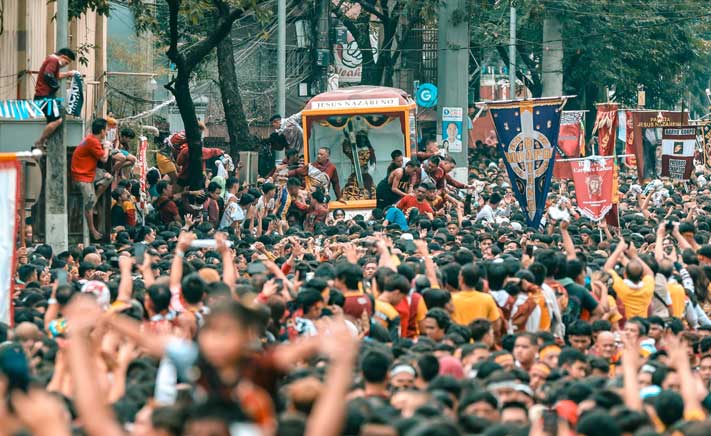
By 2008, under Msgr. Jose Clemente Ignacio, this journey solidified into a yearly phenomenon. The sight of millions pulling the andas (carriage) by thick ropes, walking barefooted along the route, against the asphalt, scorching heat and dirt, became a national icon of sacrifice. The barefoot walk is more than a tradition; it is a physical prayer, a way for the devotee to shoulder a portion of Christ’s burden.
To the casual observer, the “Traslacion” appears as a sea of frantic movement. But to the Hijos and the millions of devotees, it is “organized chaos.” It is a delicate, unspoken choreography of trust. Within the heat and the crush, devotees lift one another up, pass towels to the carriage, and guide the rope with a singular purpose.
The belief is simple yet absolute: to touch the rope or the andas is to touch the hem of the Divine. It is a quest for healing not just of the body, but of the spirit. After four centuries, the devotion has not faded; it has only deepened, proving that for the faithful, the journey is just as sacred as the destination.
From 2008 to present, it was in 2014 that Quiapo Church had a total number of estimated devotee of 10 million while in 2017 as its longest procession with 22 hours and 19 minutes. While last year setting its record with 20 hours and 45 minutes of “Traslacion” and 8.12 Million devotees putting in the highest recorded attendance in history.
2026 Feast Schedule
This year’s observance continues the tradition of fervent prayer and penance:
January 8, 2026: Kick-off ceremonies and vigil at the Quirino Grandstand.
January 9, 2026: The dawn start of the Traslacion, awaiting the return of the image of Jesus Nazareno to Quiapo Church.
A Spiritual Resolution: Carrying the Cross Daily
The profound devotion to the Black Nazarene is a powerful reminder that the Christian life is a daily “Traslacion” is a continuous journey of carrying our own crosses in imitation of Christ. The physical sacrifice of the barefoot walk is a momentary act, but the spiritual challenge is to maintain that same fervor and penitential spirit throughout the year.
To truly honor the Nazareno, the faithful are called to embrace the Sacramental life of the Church:
- The Sacrament of Confession: To unburden the soul of the weight of sin, which is the heaviest cross we carry, and to receive the grace of reconciliation.
- The Holy Eucharist: To participate actively in the Holy Mass and receive the Eucharist, the true Body and Blood of Christ, which strengthens us for the journey and unites our suffering to His.
- Contemplative Prayer: To spend time in Eucharistic Adoration and to pray the Rosary, meditating on the Sorrowful Mysteries, which are the very essence of the Nazareno’s journey.
The Black Nazarene does not promise a life without suffering, but a life where suffering is redemptive when united to His. Let the devotion inspire us to heed the words of Christ: “If anyone wishes to come after me, he must deny himself and take up his cross daily and follow me.” (Luke 9:23).