In today’s world, we are often surrounded by sadness and noise. Life can feel uncertain, lonely, and heavy. Sometimes, even our faith feels shaken, as if the ground beneath us is not steady.
But the history of the Church shows us something different. It teaches us that joy can still grow—even in the hardest times. This joy does not run away from suffering. Instead, it turns pain into prayer and hope.
This is like a “celebration” in heaven, a reminder that we are not alone, even in our struggles.
We see this clearly in the story of Nagasaki. Despite great suffering and loss, the faith of the people remained strong. Their courage and endurance turned their pain into a powerful witness, a story not of defeat, but of hope and victory.
Singing from the Wood: The Joy of St. Paul Miki (1562–1597)
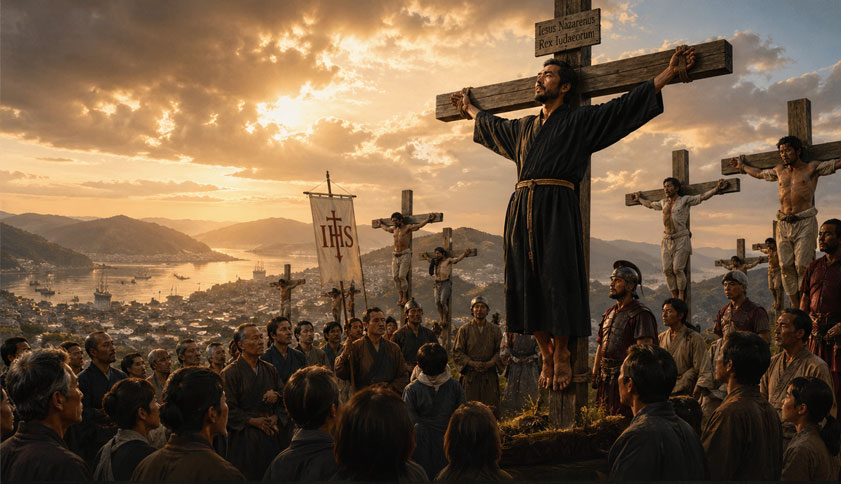
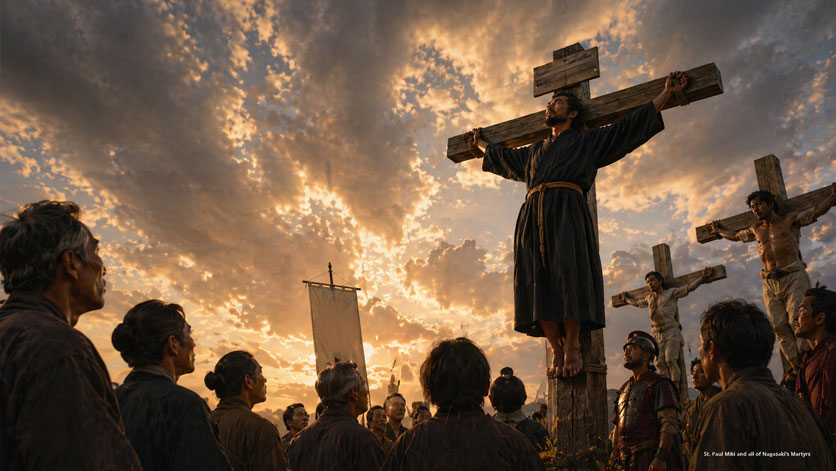
Every February 6, we commemorate St. Paul Miki and his twenty-five companions, the first martyrs of Japan. Their witness was not a passive submission to fate, but a literal imitation of the crucified Lord. As they were led to the site of their execution, they did not see an end, but a beginning. The Theology of Martyrdom found in the Letter to the Hebrews reminds us that we approach a “festal gathering” of angels; for these Jesuits, Franciscans, and laypeople, the hills of Nagasaki became that very sanctuary.
The moment they caught sight of the crosses and instruments of torture prepared for them, their reaction was profoundly counter-intuitive to the world, yet perfectly consistent with the Gospel. They did not recoil, they rejoiced in the work ahead of them.
“They saw the crosses laid out before them; they knew they would be crucified; they rejoiced in that work… and they began to sing the Te Deum.”
By lifting their voices in this ancient hymn of praise, St. Paul Miki and his companions transformed a public execution into a liturgical victory. This act of defiance shifted the narrative from a tragedy to a triumph, proving that the song of the soul remains untouchable even when the body is bound to the wood.
The Crimson Thread: A Faith that Endures Centuries
The sacrifice of these first martyrs was not a solitary event, but the planting of a seed with a supernatural lifespan. Their blood became the heart of an enduring faith that survived in the shadows for centuries. This was the “apostolic succession of suffering,” where a faithful remnant, denied priests and public churches, preserved the oral tradition and the secret fire of the Gospel.
This endurance was the fruit of the original martyrs’ Te Deum. The memory of their joy sustained the community through waves of persecution, ensuring that the Catholic identity of Nagasaki was not merely a historical footnote, but a living, breathing reality. By the mid-20th century, this resilient faith had moved from the secret “Hidden Christian” communities into the vibrant life of a cathedral, yet the spirit of the martyrs remained its core strength.
A Modern Bridge: The Nagasaki Bell Project
Today, this legacy of “burning endurance” is being carried forward through the Nagasaki Bell Project. This initiative seeks to restore the missing bell to the Nagasaki Cathedral, serving as a sign of profound solidarity between the Catholic communities of Japan and the United States.
This is more than a historical restoration; it is a strategic bridge of peace. The project links the modern faithful to the original Te Deum sung on the crosses of the 16th century. When the new bell eventually rings, it will not merely sound a note of memory, but will literally continue the song of St. Paul Miki. It is a message of joy and a longing for the peace that only Jesus Christ, our Savior, can provide a harmony that transcends borders and centuries.
A Burning Endurance for Our Time
The legacy of the Nagasaki Catholics challenges us to move beyond a fragile faith that only thrives in comfort. Their history calls us to a “burning endurance”—a faith that perseveres through our own trials with the same liturgical courage that once rang out from the crosses and the ruins.
As we navigate the complexities of our own lives, we must decide if we will be silenced by our circumstances or if we will join the martyrs’ choir.
In the silence of your own “rubble,” is your heart composing a lament, or is it echoing the Te Deum of the martyrs?
A Spiritual Resolution for the Modern Faithful
As we reflect on the joy of the martyrs and the resilience of the Nagasaki survivors, we are called to a spiritual resolution. To maintain the “burning endurance” requested in the prayer of the Mass for St. Paul Miki, Catholics are encouraged to ground their lives in five essential pillars of the faith:
1. The Sacrament of Confession The martyrs were able to face the cross with joy because their souls were prepared for the “heavenly Jerusalem”. Regular recourse to the Sacrament of Penance cleanses the heart and fortifies the will, allowing us to face our daily “crosses” with the same clarity and peace shown by St. Paul Miki and his companions.
2. Eucharistic Adoration The physician in the ruins of Nagasaki sought the bell to remind the people of God’s presence. In Adoration, we sit before the “City of the Living God” truly present in the Monstrance. Spending time in silence before the Blessed Sacrament provides the spiritual strength necessary to endure seasons of “devastation” and personal loss.
3. The Holy Rosary The faith in Japan survived for centuries without priests, largely through the private devotion of the “Hidden Catholics.” The Rosary remains the preeminent weapon of the faithful, a means of meditating on the mysteries of Christ’s life, death, and resurrection—the same mysteries the Nagasaki martyrs lived out in their own flesh.
4. Receiving the Eucharist through the Mass Father Patrick reminds us that at Mass, we “approach Mount Zion”. The Eucharist is the source of the “enduring faith” that characterized the Nagasaki community. By receiving the Body and Blood of Christ, we are physically and spiritually united to the sacrifice of the martyrs and the hope of the Resurrection.
5. The Holy Scriptures To understand the “Theology of Martyrdom,” we must remain rooted in the Word of God, specifically texts like the Letter to the Hebrews which frame our trials as a journey toward the Living God. The Scriptures provide the map for our endurance and the promise of the peace that “only Jesus Christ Our Savior can bring”.
To remain informed about Catholic life, teachings, and global Church developments, readers may be encouraged to visit www.ewtnvatican.com for trusted Catholic news and resources.