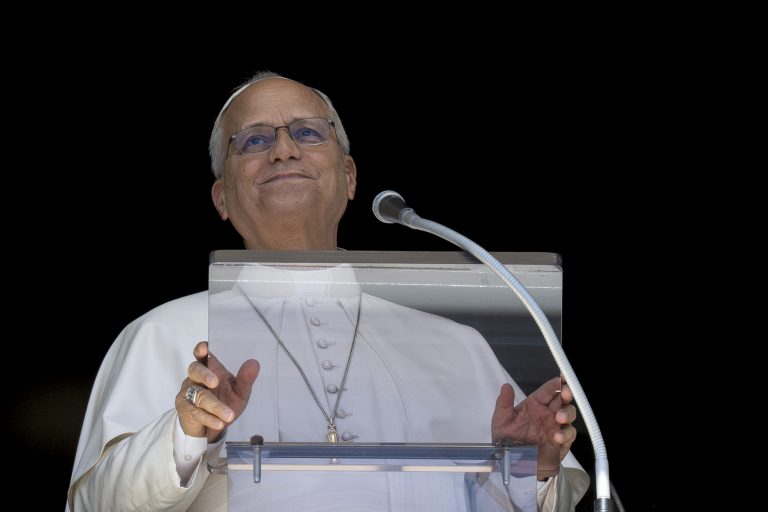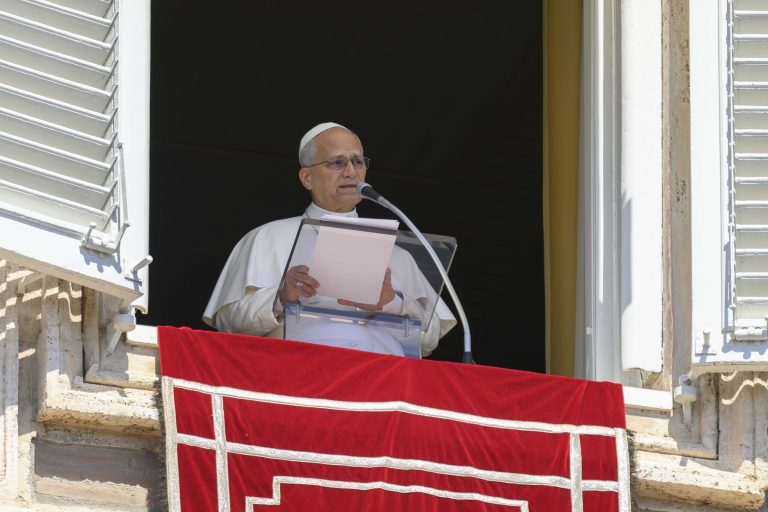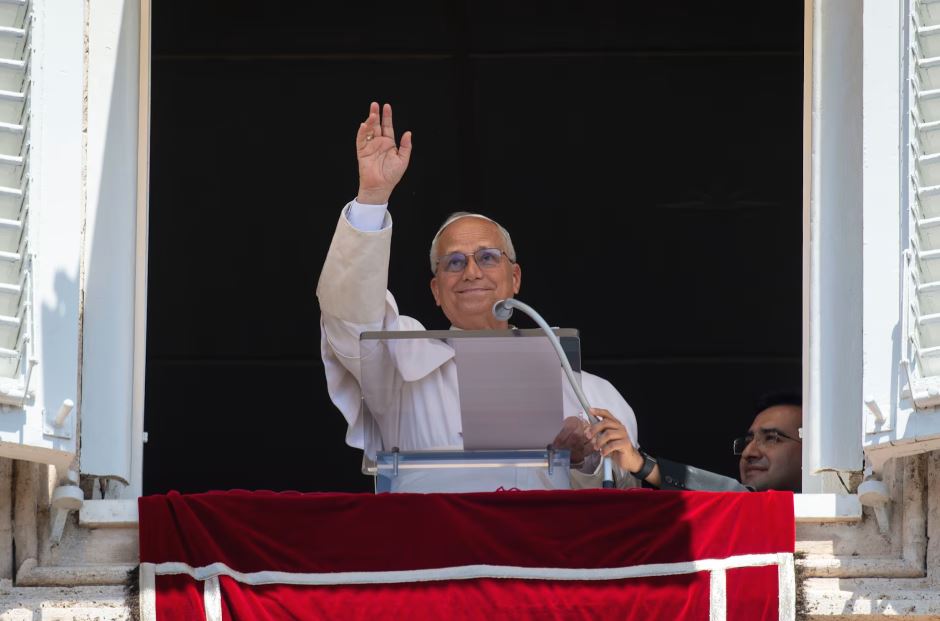
Pope Leo XIV greets pilgrims gathered in St. Peter’s Square at the Vatican for the recitation of the Angelus on June 14, 2026. | Credit: Vatican Media
VATICAN CITY — Standing at the window of the Apostolic Palace overlooking St. Peter’s Square on Sunday, June 14, 2026, Pope Leo XIV paused after the Angelus prayer to speak directly to the people of the Philippines, a country he knows not from a distance, but from personal experience.
“I assure the people of the Philippines, struck a few days ago by a powerful earthquake, of my closeness,” the Pope said, in words released in an official English translation by the Vatican. “I pray for the deceased and their families, for the wounded and for all those suffering because of this disaster”.
His words came one week after a magnitude 7.8 earthquake struck off the coast of Sarangani in southern Mindanao on the morning of June 8, killing at least 61 people, leaving 40 others missing, and injuring more than 1,400. The disaster struck on the opening day of classes, sending students and teachers fleeing from their classrooms as buildings shook and, in some cases, collapsed.
A Pope Who Has Walked Philippine Soil
What gives Pope Leo XIV’s expression of solidarity particular weight is the personal bond he has built with the Philippines over many years. Before his election to the papacy in May 2025, he served as Superior General of the Order of St. Augustine — the first Augustinian to be elected Pope in the history of the Church. In that role, he visited the Philippines on several occasions, including trips in 2002, 2010, and 2012, to visit the Augustinian communities that have served the country for centuries.
The Augustinians arrived in the Philippines in 1565 — the first religious order to set foot in the archipelago — and have been a cornerstone of Filipino Catholic life ever since. Their churches, many of which are UNESCO World Heritage Sites, stand as monuments to a faith that has endured conquest, colonialism, war, and natural disaster. For Pope Leo XIV, the Philippines is not simply a country on a map; it is a community of faith he has prayed with, broken bread with, and walked alongside.
The Church in the Philippines Responds
Even before the Pope’s words reached Manila, the Catholic Bishops’ Conference of the Philippines (CBCP) had already moved swiftly to mobilize the Church’s network of parishes and dioceses in support of the victims. CBCP President Archbishop Pablo Virgilio David called on all bishops to authorize a second collection at Sunday Masses on June 14 — the same day the Pope was praying for the victims in Rome — with all proceeds directed to earthquake relief.
“I appeal to all bishops to authorize a second collection in their respective dioceses during the Sunday Masses of June 14, 2026,” Archbishop David said. “The proceeds will go to the victims of the earthquake”. Radio Veritas Asia reported that the bishops also called for nationwide prayers and a sustained aid drive for those who had lost their homes and livelihoods.
The response has been immediate and generous. Caritas Philippines, the Church’s official humanitarian arm, coordinated relief operations in the hardest-hit areas of the Soccsksargen and Davao regions, working alongside local dioceses and government agencies. The Diocese of Marbel and the Diocese of General Santos, both of which cover the affected areas, deployed their parish networks to identify and assist the most vulnerable families.
| Updated Disaster Statistics (as of June 14, 2026) | Figures |
| Deaths | 61 confirmed |
| Missing | 40 persons |
| Injured | 1,403 individuals |
| Students affected | 3,239,964 across 6,224 public schools |
| Regions affected | IX, X, XI, XII, and Caraga |
“Your Life Is More Important Than Anything Left Behind”
The earthquake, which struck at 7:37 in the morning, was felt across a vast stretch of Mindanao and triggered tsunami waves of up to 1.4 metres along nearby coastlines. Tsunami warnings were issued across the Philippines, Indonesia, Palau, Taiwan, and Papua New Guinea. President Ferdinand Marcos suspended classes in all affected areas and urged coastal residents to evacuate without delay: “Move to higher ground now. Do not wait. Your life is more important than anything left behind”.
Among the most striking images of the disaster was the partial collapse of a building at Notre Dame of Dadiangas University in General Santos City — a Catholic institution founded by the Marist Brothers in 1953. A three-story commercial building housing a Jollibee restaurant and a Love Radio station also collapsed in the city, while parts of SM City General Santos sustained major damage. Aftershocks have continued in the days since, including a magnitude 4.9 tremor that jolted Sarangani on June 15.
A Nation That Rises
The Philippines sits on the Pacific Ring of Fire, a belt of intense seismic activity that makes earthquakes a near-daily reality for its people. The country has faced this reality with a resilience deeply rooted in faith. Time and again, in the aftermath of typhoons, volcanic eruptions, and earthquakes, Filipino Catholics have gathered in their damaged churches, prayed the Rosary in the rubble, and rebuilt — not just their homes, but their communities.
Pope Leo XIV’s prayer from the window of St. Peter’s is a reminder that the Church is not an institution that watches suffering from a safe distance. It is a community that suffers with its members, prays with them, and works alongside them. His words — “I assure you of my closeness” — are not merely diplomatic. They are the words of a pastor who has stood on Philippine soil, who has seen the faith of its people, and who carries them in his heart.
As we unite our prayers with those of Pope Leo XIV for the victims of the Mindanao, Philippines earthquake, let us resolve to:
The Sacrament of Confession: To seek God’s grace to open our hearts more generously to those who are suffering, turning away from indifference and toward a real commitment to help our brothers and sisters in need.
Eucharistic Adoration: To pray for the repose of the souls of the 61 who have died, for the healing of the more than 1,400 injured, and for the strength of those searching for the 40 still missing.
The Holy Rosary: To entrust the people of Mindanao to the care of Our Lady of Peace and Good Voyage, asking her to bring comfort to grieving families and courage to rescue workers.
The Holy Mass: To participate with a generous heart, supporting the second collection or any other relief effort organized by our local diocese, knowing that our offering reaches real people in real need.
Sacred Scripture: To draw strength from the words of St. Paul: “Bear one another’s burdens, and so fulfil the law of Christ” (Galatians 6:2), committing ourselves to stand with the people of Mindanao in the long work of rebuilding.
To remain informed about Catholic life, teachings, and global Church developments, readers may be encouraged to visit www.ewtnvatican.com for trusted Catholic news and resources.