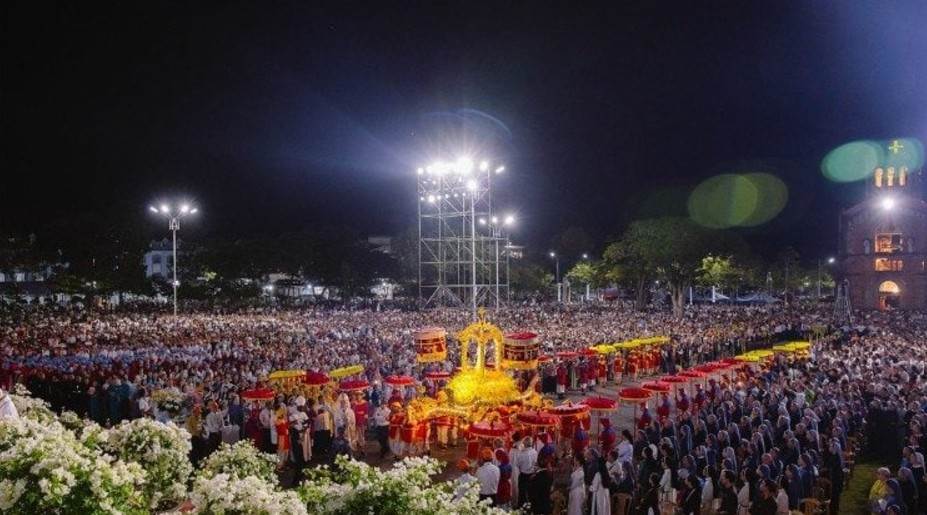
On August 13, a single Marian hymn rose from two places at once, more than 12,000 kilometers apart. At Vietnam’s national shrine in Quang Tri province, a choir from the Archdiocese of Hanoi opened the annual national pilgrimage by singing “Mot Troi La Vang,” or “Under the La Vang Sky.” At the very same time, Vietnamese Catholics gathered across the United States were singing the identical hymn. That simultaneous act of devotion, separated by an ocean yet united in song, captures something essential about how Our Lady of La Vang has come to live on far beyond the country where the devotion first began.
A 1798 Apparition Born From Persecution
According to Catholic tradition, the devotion began in 1798, when Mary reportedly appeared to persecuted Catholics hiding in La Vang’s forests, offering comfort and guidance. The site became Vietnam’s national Marian pilgrimage center in 1959 and a minor basilica in 1961. A triennial national pilgrimage, dating to 1928, continues today despite the original shrine’s destruction during the Vietnam War.
The image of Our Lady of La Vang carries distinctly Vietnamese features, depicted wearing the traditional áo dài dress and khan dong headpiece while holding the infant Jesus, a cultural representation many Vietnamese Catholics describe as holding a place in their spiritual life similar to what Our Lady of Guadalupe represents for Mexican Catholics.
How La Vang Devotion Crossed Oceans With the Diaspora
The devotion’s global reach traces directly back to 1975, when the fall of Saigon sent more than a million Vietnamese fleeing as refugees, many of them Catholics who settled in the United States, Canada, Australia, and France. Rather than leaving their devotion behind, these communities carried it with them, building new shrines and parishes dedicated to Our Lady of La Vang across their new homelands. The National Shrine of Our Lady of La Vang in Washington, D.C., completed in 2005, incorporates stars throughout its sanctuary as a deliberate design choice, a quiet reminder of the stars refugees once used to help guide their journey to safety.
The devotion’s global expansion also received formal Church recognition. In 2002, Pope John Paul II blessed six Our Lady of La Vang statues in Rome for six continents. In 2021, a $12.6 million shrine at Christ Cathedral in Orange County, California, was blessed after a worldwide campaign involving more than 5,000 donors. In 2010, an “Overseas Diocese” stone symbolically recognized the global Vietnamese Catholic diaspora as a twenty-seventh diocese of the wider Vietnamese Church.
Why This Devotion Is Significant for the Church Today
This story carries genuine significance for the Church, and in this case, the significance is deeply encouraging. Devotion to Our Lady of La Vang offers a remarkable example of how a specific, culturally rooted Marian tradition can travel with a displaced people and flourish abroad without losing its distinct identity, preserved through language, dress, and hymnody, while simultaneously becoming a genuinely universal expression of faith, formally recognized and distributed across six continents by the Church’s own highest authority. That a devotion born from persecution and hardship in 1798 continues to comfort and unite a global community more than two centuries later speaks to something enduring about how faith survives displacement rather than being erased by it.
At the same time, an honest reading of this global growth invites one thoughtful consideration. Devotions this closely tied to a specific national and historical experience of trauma can, without deliberate effort, risk becoming primarily markers of cultural heritage for subsequent generations born abroad, particularly those who may not speak Vietnamese fluently or share the same direct connection to the community’s refugee history. Ensuring this devotion remains a living, actively practiced expression of faith for younger generations, rather than gradually settling into a once-a-year cultural commemoration, remains an important, ongoing pastoral consideration for Vietnamese Catholic communities worldwide.
One Hymn, Two Continents, One Church
The image of the same hymn rising simultaneously from Quang Tri province and from parishes across the United States offers a striking, concrete picture of a theological truth the Church has always professed: that the Body of Christ transcends geography entirely, united in worship regardless of distance. This is the Communion of Saints made audible, believers separated by 12,000 kilometers joined in a single act of praise directed toward the same Mother.
The star imagery woven into the Washington, D.C. shrine adds another layer of spiritual resonance. Mary has long been venerated under the title Star of the Sea, a guide for travelers and those in peril, a title that takes on particular poignancy for a community whose journey to safety often involved perilous escape by boat across open ocean, guided quite literally by starlight in the absence of any other navigation.
A Spiritual Resolution
- Confession, offered during major pilgrimages and feast days, allows devotees to approach Our Lady of La Vang each year with genuinely renewed hearts rather than routine cultural observance.
- Adoration, practiced quietly within families, deepens a devotion that might otherwise remain confined to a single annual pilgrimage or celebration.
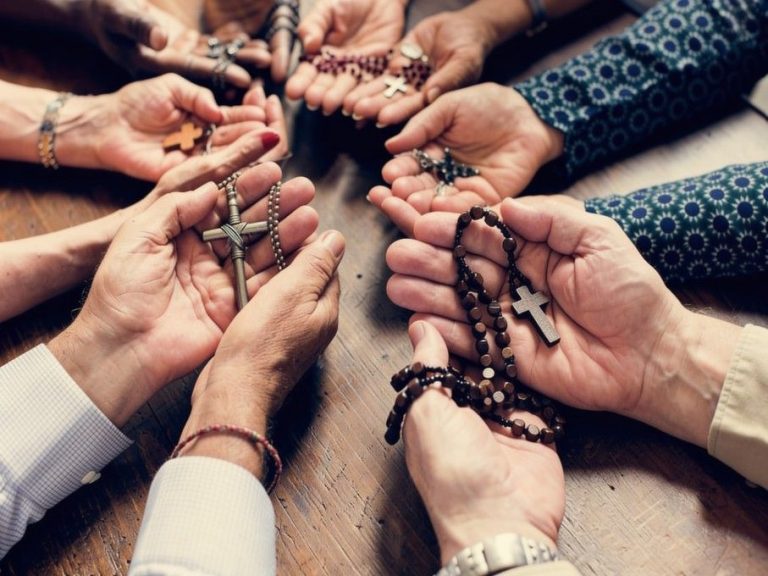
- The Rosary, prayed regularly in Vietnamese households worldwide, remains the most direct and enduring way this devotion continues passing from grandparents to grandchildren.
- The Eucharist, celebrated at shrines from Quang Tri to Washington, D.C. to Orange County, unites this global community in something even deeper than shared heritage or hymnody.
- Scripture, particularly its account of Mary’s own faithful endurance through hardship, grounds this devotion in something more permanent than any single historical experience of persecution or displacement.
Keeping a devotion like this genuinely alive across generations and continents requires more than shrines and statues alone; it requires ordinary spiritual practices lived out consistently within families and communities. Five such practices offer a steady foundation for that ongoing transmission.
To remain informed about Catholic life, teachings, and global Church developments, readers may be encouraged to visit www.ewtnvatican.com for trusted Catholic news and resources. Or watch catholic programming via EWTN flix app or EWTN Asia Pacific’s On Demand section