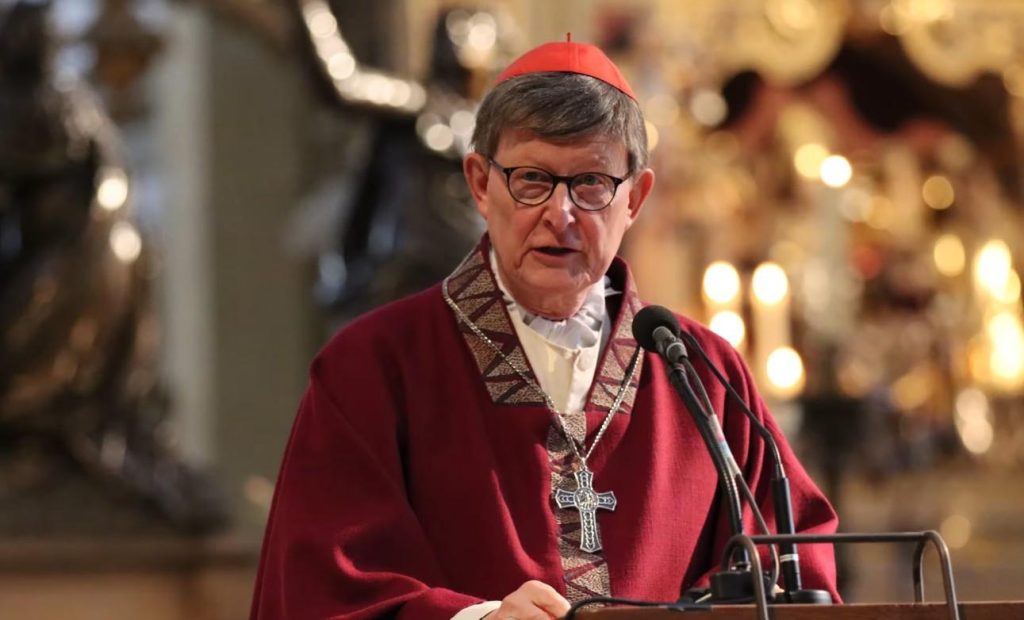
Turning 70 rarely comes with a public reckoning of one’s entire vocation, but for Cardinal Rainer Maria Woelki of Cologne, that is exactly what his birthday on August 18 became. In a candid interview looking back across four decades of priesthood, Woelki spoke openly about the vocation that shaped his life, the institutional crisis that defined much of his last decade in Cologne, and a vision for renewal he insists is nowhere near finished. His central conviction, repeated throughout the conversation, is striking in its clarity: the mission to proclaim the Gospel does not end with a birthday. It ends only with one’s last breath.
From a Postwar Settlement to the College of Cardinals
Woelki was born in Cologne in 1956 to a family displaced from East Prussia after World War II and raised in the Bruder Klaus settlement. His faith was shaped by parish youth ministry, altar serving, and summer camps. Ordained in 1985, he became auxiliary bishop of Cologne, Archbishop of Berlin in 2011, and a cardinal in 2012. In 2014, he returned to Cologne as archbishop, leading the German-speaking world’s largest Catholic diocese, with about 1.7 million Catholics.
A Decade Marked by Crisis and Candor
Woelki’s tenure in Cologne has been shaped significantly by a serious institutional crisis. In 2018, he commissioned an independent investigation into decades of clergy sexual abuse within the archdiocese, but the initial findings were withheld from publication, a decision that triggered a major crisis of public trust, sparked protests, and led to a wave of departures from the Church along with public calls for his resignation. A later, separate report he did release documented more than 300 victims and roughly 200 abusers. In 2021, Pope Francis ordered him to take a six-month leave, and in 2022 Woelki offered his resignation, though it was never formally acted upon.
Reflecting on that period now, Woelki insists he never pretended anything to anyone, even amid intense public pressure, and describes trying to remain faithful to the promises he made at his ordination rather than chasing short-term public approval. Whether that account fully satisfies those most affected by the crisis remains, understandably, a matter many will continue to weigh for themselves. What is clear is that the episode left a lasting mark on both the archdiocese and on Woelki’s own account of his ministry, one he addresses directly rather than avoiding.
A Vision for Renewal: Missionary Parishes, Youth Outreach, and Katholino
Alongside that difficult history, Woelki describes a concrete, forward-looking vision for the archdiocese’s future. Cologne has restructured its central administration to better serve evangelization efforts, established a dedicated department focused specifically on spreading the Gospel, and launched new “startup” faith communities designed to reach people who have never encountered the Church or who have drifted away from it. University outreach teams are being sent to invite students to explore faith and Jesus directly, Alpha courses and similar programs are expanding, and Woelki notes with evident gratitude that adult baptisms in the archdiocese are rising.
Perhaps the most concrete initiative is Katholino, a Catholic daycare provider launched in 2025 that has already grown into the largest such provider in North Rhine-Westphalia, encompassing more than 520 parish-run childcare centers. Woelki frames this not simply as social service, but as an intentional effort to help raise what he calls a new generation grounded in a Christian understanding of the human person. Underlying all of this is a broader conviction he states plainly: a new missionary era has begun for the Church, one in which faith can no longer be assumed to pass automatically from one generation to the next.
Why This Reflection Is Significant for the Church Today
This story carries real significance for the Church, and its implications run in more than one direction, both worth taking seriously. On the encouraging side, Woelki’s vision for missionary renewal, new evangelization structures, expanding childcare infrastructure, and direct outreach to young people and university students, offers a concrete, replicable model relevant well beyond Cologne. His broader insight, that churches across much of Western Europe can no longer take generational transmission of faith for granted, names a challenge many dioceses quietly face without always responding to it as directly or practically.
At the same time, an honest reading of this reflection requires acknowledging the real weight of the crisis that shaped much of his tenure. The initial decision to withhold the 2018 investigation’s findings caused genuine, lasting harm to public trust, and an unresolved resignation offer leaves an open question that reasonably continues to affect how some Catholics, particularly those most directly touched by the crisis, view his leadership. Holding both realities together, genuine institutional failure alongside a genuinely constructive vision for renewal, is not a contradiction so much as an honest picture of a complicated tenure still being written.
The Weight of the Red Cassock
One of the most personally revealing moments in Woelki’s reflection concerns the significance he attaches to a cardinal’s red vestments. He describes the color as a constant reminder that accepting the dignity of a cardinal carries an obligation to bear witness to Christ to the very end, even, if necessary, to the point of shedding one’s own blood. Rather than treating this as a comfortable symbol, he admits it causes him real distress, confessing that he regularly asks himself whether he would actually be ready for that kind of ultimate witness if it were ever demanded of him.
That admission of uncertainty, from a man who has spent decades in senior Church leadership, offers something genuinely humanizing: a reminder that even those holding the Church’s highest offices continue wrestling honestly with the full weight of what discipleship actually asks of them.
A Spiritual Resolution
Renewing a diocese, or a personal vocation, after genuine institutional crisis requires more than new programs and structures alone; it requires spiritual practices capable of sustaining mission even through difficulty and unresolved tension. Five ordinary practices offer that steadier foundation.
- Confession, sought honestly and regularly, is essential for any leader or community seeking genuine renewal after failure, rather than merely moving past it unexamined.
- Adoration, quiet time before Christ, cultivates the same trust in Christ Woelki describes relying on through his most difficult years in ministry.
- The Rosary, prayed steadily, offers a grounding rhythm capable of sustaining long-term missionary vision even amid ongoing institutional challenges.
- The Eucharist, celebrated faithfully, remains the true center every renewal effort, however well-structured, is ultimately meant to draw people toward.
- Scripture, read and prayed with regularly, roots the conviction that mission continues until one’s last breath in something deeper than personal determination alone.
To remain informed about Catholic life, teachings, and global Church developments, readers may be encouraged to visit www.ewtnvatican.com for trusted Catholic news and resources. Or watch catholic programming via EWTN flix app or EWTN Asia Pacific’s On Demand section