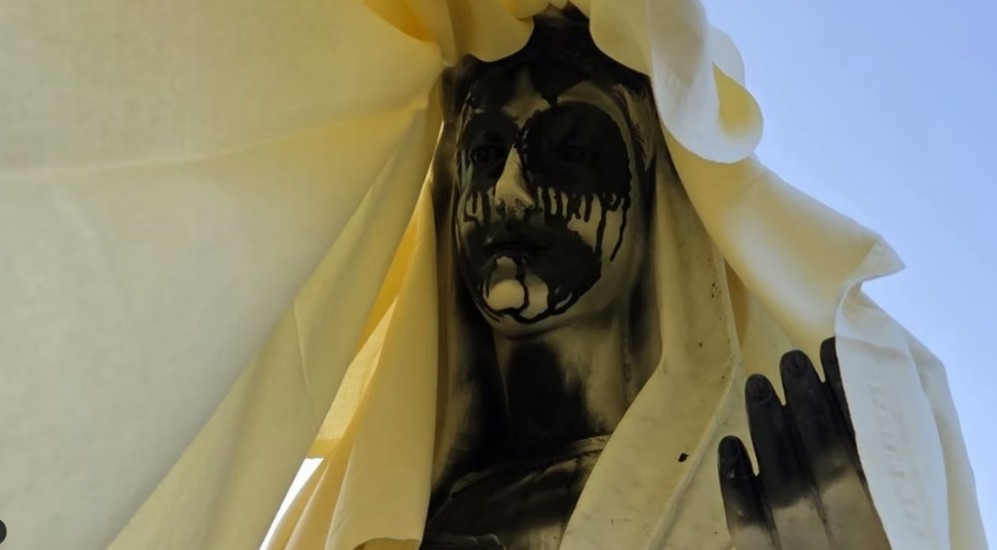
One of the world’s most visited Catholic pilgrimage sites woke up to devastation this week. On July 27, vandals struck several sacred locations in Medjugorje, Bosnia and Herzegovina, defacing statues of the Virgin Mary with black paint and blasphemous graffiti before setting fire to the outdoor altar behind St. James Church. The attack came just days before one of the shrine’s largest annual gatherings, where about a million pilgrims visit each year. Yet beyond the damage itself, the community’s response offers a powerful witness to faith enduring in the face of desecration.
What Happened at Medjugorje: A Timeline of the Overnight Attack
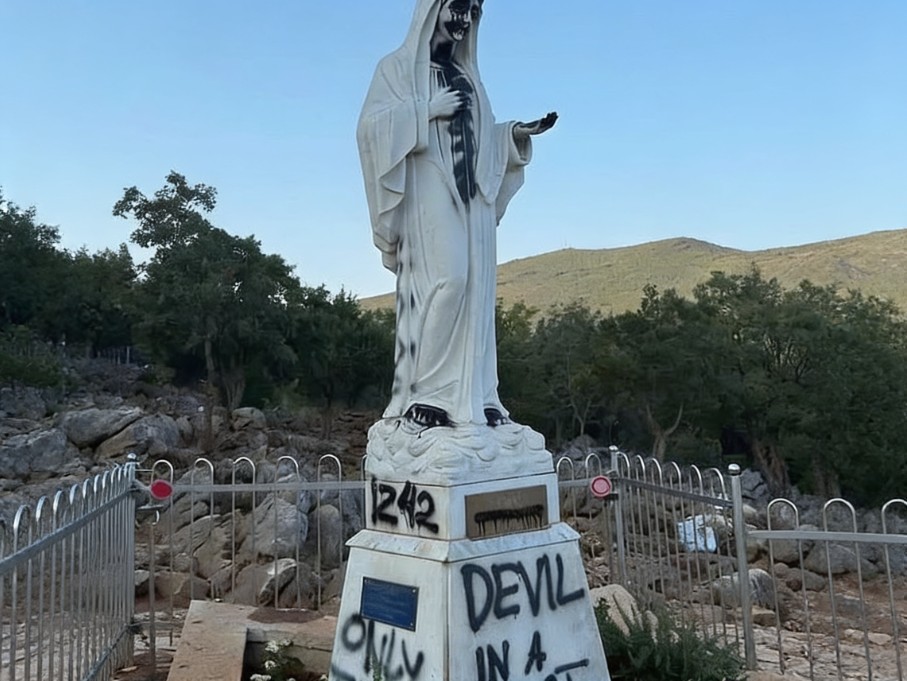
Police in the Herzegovina-Neretva canton received their first report at approximately 4:30 a.m., after the statue of Our Lady on Podbrdo, better known as Apparition Hill, was found with its face and hands covered in black paint. The pedestal beneath it had been spray-painted with the words “Devil in a skirt.” A second statue near the nearby Blue Cross was similarly defaced, with the word “EVIL” scrawled on a stone slab close by.
Roughly thirty minutes later, at around 5:00 a.m., a fire broke out at the outdoor altar behind St. James Church. Surveillance footage reviewed by investigators reportedly showed a man pouring a flammable liquid around the altar before igniting it. Bosnian police secured the area and arrested a suspect the same day, though authorities have not released his identity while they work to determine a motive and whether he is connected to additional graffiti reported at Cross Mountain and other pilgrimage locations that same night. The timing struck many as especially jarring: the attack occurred just days before Medjugorje’s annual Mladifest youth festival, which typically draws tens of thousands of young Catholics from around the world.
The Parish’s Response: Prayer, Fasting, and Forgiveness Over Anger
Perhaps the most striking part of this story is not the vandalism itself but how the local Church chose to respond. In a statement released the same day, the Medjugorje parish office said it received the news with great sadness, while explicitly urging pilgrims and the wider Catholic community to answer with prayer, fasting, and forgiveness rather than anger or retaliation. Cleanup and repair work began almost immediately, with parish staff working to restore the damaged sites so that prayer could resume as quickly as possible.
That response was echoed beyond the Catholic community itself. The Interreligious Council in Bosnia and Herzegovina condemned the attack as a profound insult, describing it as an assault on the peace, mutual respect, and dignity shared by all people in the country, regardless of faith. That kind of cross-religious solidarity, in a region with its own long history of religious and ethnic tension, added an unexpected layer of significance to an already painful moment.
Why This Attack Is Significant for the Church Today
This incident carries real significance for the Church, and its implications run in more than one direction. On the concerning side, it reflects a broader and troubling pattern of vandalism and desecration targeting Christian sacred sites in various parts of the world in recent years, a trend that leaves historic shrines, some centuries old and drawing millions of visitors, more visibly vulnerable than many pilgrims previously assumed. An attack timed so close to Mladifest, one of the shrine’s largest annual youth gatherings, only sharpens that concern, raising legitimate questions about security at major pilgrimage sites during peak visitation periods.
On the more hopeful side, the Church’s response offers a genuinely constructive counter-example at a moment when reflexive outrage might have been expected instead. Choosing prayer, fasting, and forgiveness over anger is not simply a public relations strategy; it reflects a core Christian conviction that evil is best answered with grace rather than mirrored retaliation. The swift, unified condemnation from Bosnia’s interreligious community further suggests that acts intended to divide can, when met with restraint rather than escalation, instead produce broader solidarity across religious lines. Coverage from outlets following the story closely, including EWTN Asia Pacific News, has helped ensure that this message of restraint and faith, rather than only the damage itself, reaches audiences well beyond Bosnia.
Mary at the Foot of Suffering, Once Again
There is a striking spiritual resonance in the fact that this attack targeted images of Mary specifically, the same figure who, according to the Gospel of John, stood at the foot of the Cross witnessing her own son’s public humiliation and suffering. Marian devotion has never been rooted in the idea that Mary, or those who honor her, are shielded from insult or hardship; if anything, Catholic tradition holds that suffering endured with faith, rather than suffering avoided altogether, is where grace often does its deepest work.
Medjugorje has been a site of prayer, conversion, and reconciliation for four decades, values that stand in direct opposition to an act designed to provoke division and mockery. Seen through that lens, the desecration of a statue does not diminish what the statue represents; it simply repeats, in miniature, a pattern of contempt toward the sacred that Christian faith has always understood as something to be met with endurance rather than despair.
Spiritual Resolution
The deeper spiritual resolution offered by this moment is not complicated, even if it is genuinely difficult to live out: an attack meant to wound faith need not succeed in doing so, provided the response is rooted in prayer rather than bitterness. The parish’s own call to fasting and forgiveness points toward five ordinary practices capable of sustaining that response over the difficult days ahead:
- Confession, which clears away any temptation toward bitterness or retaliation, restoring the freedom to forgive as Christ himself modeled.
- Adoration, quiet time before Christ that offers steadiness precisely when a place of prayer has itself come under attack.
- The Rosary, a fitting and specific response at a Marian shrine, offered here for the conversion of whoever is responsible and for the peace of the community.
- The Eucharist, the surest source of the grace needed to answer desecration with restoration rather than despair.
- Scripture, returned to often, particularly Christ’s own instruction to pray for those who cause harm rather than answer harm with harm of its own.
For pilgrims planning to attend Mladifest in the days following this attack, and for Catholics elsewhere reading about it from a distance, the resolution is the same: continued devotion, offered without fear, is itself a quiet but meaningful response to an act designed to intimidate.
The vandalism and arson at Medjugorje this week caused real damage to sacred statues and a beloved altar, but it did not manage to shake the spirit the site has cultivated over four decades: prayer, conversion, and reconciliation, even now, in the face of open contempt. As investigators continue working to determine a motive and whether additional suspects were involved, the shrine’s own response, grounded in forgiveness rather than fear, may end up being the more lasting story. This is a developing story, and EWTN Asia Pacific News will continue following developments as investigators release more information in the days ahead.
To remain informed about Catholic life, teachings, and global Church developments, readers may be encouraged to visit www.ewtnvatican.com for trusted Catholic news and resources.