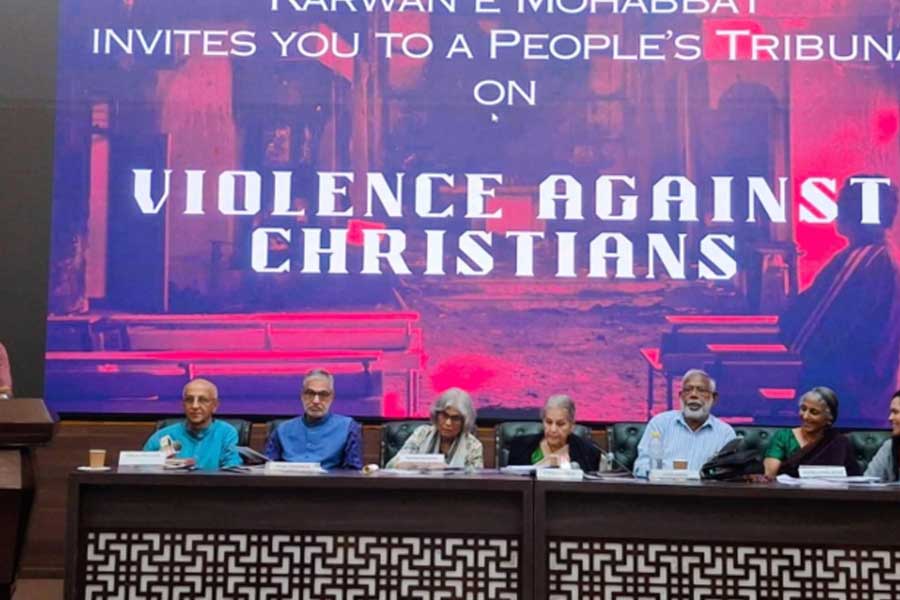
The Jury of the People’s Tribunal on Violence Against Christians in India, titled “Caravan of Love,” in New Delhi on June 1, 2026. Catholic activist John Dayal is seated third from right. | Credit: Anto Akkara
NEW DELHI, India — In a sign of the growing urgency of the crisis facing India’s Christian community, a landmark “People’s Tribunal” convened in the nation’s capital on June 1, 2026, bringing together Christian, Hindu, and Muslim voices in a unified call for justice. The tribunal, titled Caravan of Love, documented a disturbing escalation of violence and discrimination targeting Christians and urged the Indian government to end what it described as “impunity for nonstate actors”.
The event, which drew more than 200 leaders, lawyers, researchers, and delegates from across the country, heard harrowing testimony from 20 survivors of anti-Christian violence. It represents one of the most significant civil society responses to a crisis that has seen incidents of anti-Christian violence rise from 127 in 2014 to nearly 900 in 2025 which is more than six-fold increase in just over a decade.
The Constitutional Promise Is Under Threat
“The constitutional guarantees of freedom of conscience, religion, and equal citizenship are increasingly under threat,” declared John Dayal, a senior journalist and outspoken Catholic activist who organized the tribunal. His words echo the foundational teaching of the Second Vatican Council’s Dignitatis Humanae, which affirms that “the human person has a right to religious freedom” and must be “immune from coercion” in matters of faith.
The tribunal’s proceedings examined a wide range of abuses, from attacks on places of worship and the disruption of prayer meetings to the denial of burial rights, the expulsion of families from villages, and the systematic use of anti-conversion laws as a pretext for violence. A recurring concern was the alleged complicity of state institutions, with participants describing instances in which police officers “failed to protect victims, registered cases against those who had been attacked, and pressured communities into so-called compromise agreements”.
| The Scale of the Crisis | Anti-Christian Violence in India |
| 2014 | 127 documented incidents (year BJP came to power). |
| 2021 | 505 incidents recorded by the United Christian Forum. |
| 2024 | 834 incidents, a record high at the time. |
| 2025 | Nearly 900 incidents — a fifth consecutive record year. |
| 2026 | Tribunal convened to demand accountability. |

Even the Dead Are Not Spared
Among the most harrowing testimonies was that of Father Ajay Singh, former director of the Odisha Forum for Social Action of the Catholic Church. He described a “systematic denial of burial rights” as one of the gravest forms of humiliation inflicted upon Christian communities, recounting cases in which funeral processions were obstructed, burial in village graveyards was denied, and even the bodies of deceased Christians were allegedly removed and buried against the wishes of families.
“The situation has become so shocking that even dead bodies are dug out,” Father Singh told EWTN News, describing a practice of forced reconversion ceremonies performed on the remains of the deceased. This “culture of death” stands in stark contrast to the Church’s teaching on the infinite dignity of the human person, enshrined in the recent Dignitas Infinita declaration.
Vijayesh Lal, General Secretary of the Evangelical Fellowship of India, noted that accusations of conversion have become a recurring pretext for violence, while Siju Thomas of Alliance Defending Freedom India lamented the “social and economic boycotts, expulsions, and ostracization of Christians, especially of newly converted families.” The quota for a Christian member on the National Commission for Minorities has not been filled for six years.
A “Caravan of Love” Against the “Culture of Death”
The tribunal’s name, Caravan of Love, is itself a deliberate counter-witness to the “culture of death” that seeks to silence the Gospel. Harsh Mander, a prominent social activist, concluded the proceedings by deploring that the widespread violence could not be understood as isolated acts of prejudice but rather revealed “a systematic campaign of exclusion that threatened the constitutional promise of equal citizenship”.
The findings of the tribunal, which will be published in a 300-page book within two months, represent a “priceless spiritual heritage” of testimony for the universal Church. They are a “call to communion” for all people of goodwill to stand with the persecuted and to build the civilization of love in the face of hatred. As Pope Leo XIV has repeatedly emphasized, the “consistent ethic of life” demands that we defend the dignity of every human being, from the womb to the tomb.
As we reflect on the “witness of fidelity” of India’s persecuted Christians, let us resolve to stand with them in prayer and solidarity.
- The Sacrament of Confession: To seek the restoration of the soul from indifference toward the suffering of our brothers and sisters, turning our hearts to the “Splendor of Truth.”
- Eucharistic Adoration: To pray for the persecuted Church in India and for all those who suffer for their faith, seeking the intercession of the Blessed Virgin Mary, Auxilium Christianorum.
- The Holy Rosary: To entrust the cause of India’s Christians to the maternal protection of Mama Mary, seeking the “conversion of hearts” for those who persecute the faith.
- The Holy Mass: To offer our participation for the “healing of the wounds of persecution” and for the “springtime of justice” in India and throughout the world.
- Sacred Scripture: To meditate on the words of the Lord: “Blessed are those who are persecuted for righteousness’ sake, for theirs is the kingdom of heaven” (Matthew 5:10), seeking to live with the same “holy audacity” as the martyrs.
To remain informed about Catholic life, teachings, and global Church developments, readers may be encouraged to visit www.ewtnvatican.com for trusted Catholic news and resources.
Original article from: https://www.ewtnnews.com/world/asia-pacific/india-tribunal-urges-end-to-impunity-as-anti-christian-violence-climbs