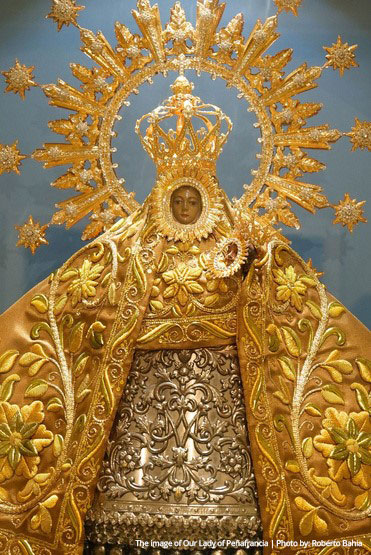
BICOL, PHILIPPINES – This Year’s Feast of Our Lady of Peñafrancia intertwines profound Marian devotion with a historic ecclesial milestone: The Diamond Jubilee of the elevation of Caceres to an Archdiocese. Embracing Mary’s maternal role over the suffragan Dioceses of Legazpi and Sorsogon since 1951, this year’s faith celebration centers on the theme, “Ina: Nurturing a growing Church.” It serves as a living testament to Mary’s enduring presence as Mater Ecclesiae (Mother of the Church) for the Bicolano faithful.
Reflecting on this spiritual journey, Archbishop Rex Andrew Alarcon emphasized Mary’s active role in guiding the local Church. “As our beloved Ina, Our Lady of Peñafrancia has been given to us as a tender and guiding mother,” the Archbishop noted in his festival message. “The theme beautifully mirrors her maternal care for our growing Church. Through her nurturing love, she accompanies us as we strive to become a truly synodal Church building the Kingdom of God in our time.”
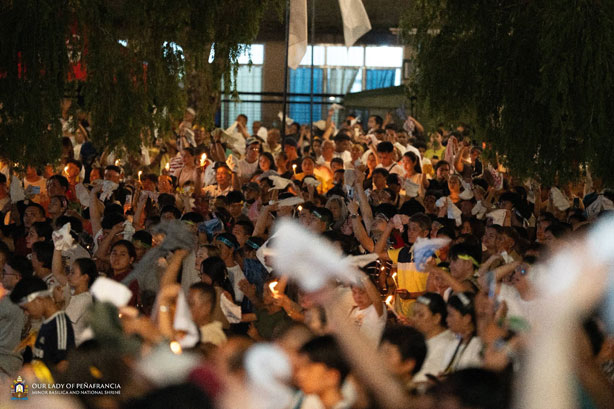
This synodal reality—walking together in faith and communion—was vividly demonstrated during the highly anticipated fluvial procession. When an unusual low tide in Naga River delayed the journey back to her home by nearly three hours, the resounding love of the devotees did not falter. Instead, the delay transformed the event into an act of communal vigil and patient endurance. Almost 1.5 million pilgrims remained steadfastly on their feet, holding onto their devotion as they awaited the passing of Ina and El Divino Rostro.
The voyaderos, the devoted men tasked with carrying, pulling, and safeguarding the sacred image, waiting in the riverbed. They watch the currents intently, waiting for the tide to rise so the grand fluvial procession can finally begin.
“We have what we call a fluvial procession, which is a procession on the water. They’re called voya because they pull the boat, which we call a pagoda. The main objective of being a voyadores is really to be influenced by Saint Joseph and Mama Mary to bring about personal transformation in your life—to be transformed from your old self into a new person.” – Engr. William Menes, Voyadores.

The Voyadores at Naga River waiting peacefully and patiently for Ina and El Divino Rostro| Photo by: Macky Pagal
For the faithful in Bicol, waiting along these riverbanks holds deep sacramental resonance. Fr. Eugene Lubigan, Rector and Parish Priest of the Minor Basilica and National Shrine of Our Lady of Peñafrancia, captures the spiritual significance of this geography: “But for us Bicolanos, that river—is very important. It isn’t just significant for commerce; it’s also significant in our spiritual lives. Because water is used by God to purify us, like in baptism, which is why we also view the water of Naga River as an instrument of God to cleanse us. That’s why the fluvial procession holds a similar significance: God carries us, we pass through the water, and we are purified until we return to Him.
The unexpected low tide also beautifully echoed the mystery of the Wedding at Cana, in which coincides with what Archbishop Alarcon also mentioned on his festival message: “In Sacred Scripture, Mary stands as a spiritual mother who calls every faithful to participate in the Church by directing them to follow Jesus.” Just as the wine ran dry at the wedding feast, the waters of the Naga River ran low, presenting a situation entirely beyond human control. Yet, in both instances, the faithful are called to mirror Mary’s quiet trust in divine providence. Her timeless instruction at Cana—“Do whatever He tells you” (John 2:5)—became a lived reality for the millions who waited patiently, offering their time as a sacrifice of devotion.
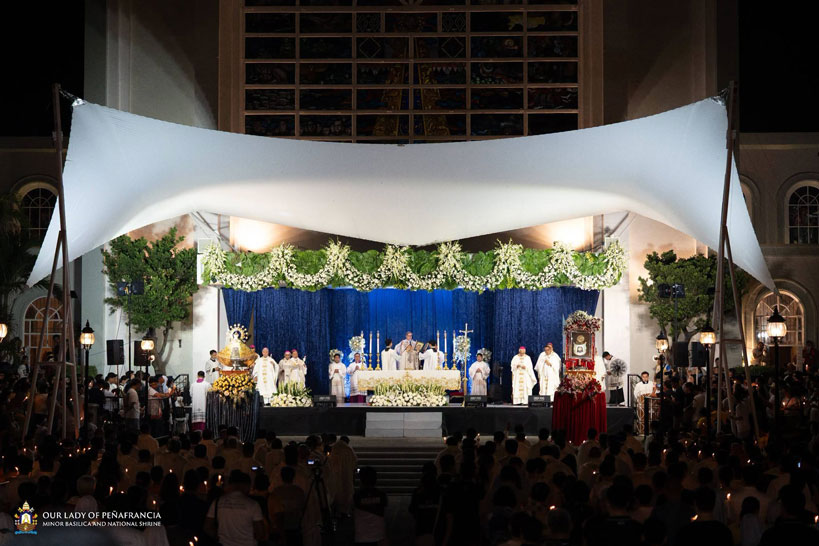
The Eucharistic Celebration at 10:00 PM presided by Most. Rev. Midyphil B. Billones, D.D., Archbishop of Jaro | Photo by: Vince Carlo Puno
Just as the scarcity at Cana was transformed into abundance, this quiet surrender along the riverbanks culminated in the highest form of Catholic thanksgiving: the Holy Eucharist. The fluvial procession ended in a profound outpouring of grace during the Mass presided over by Most Rev. Midyphil B. Billones, D.D., Archbishop of Jaro, and concelebrated by the bishops of Bicol, reminding the faithful that Mary always leads her children directly to Christ.
Viva La Virgen! Viva El Divino Rostro!