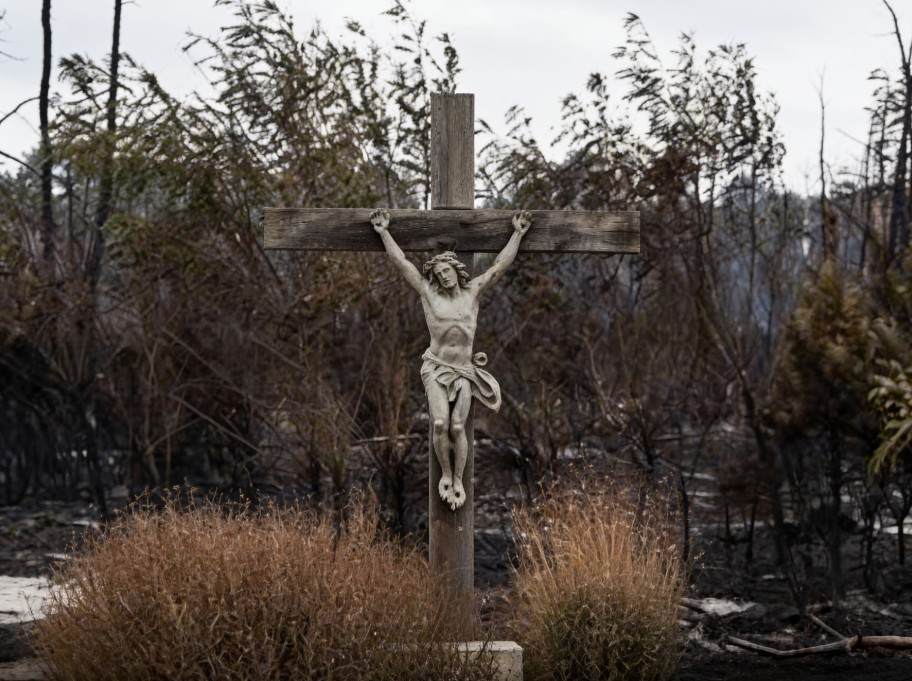
France is facing one of the most destructive wildfire crises in its modern history, with entire neighborhoods reduced to ash and hundreds of thousands of people forced to flee their homes. Amid that devastation, one image has quietly moved believers around the world: a crucifix, left standing untouched while everything around it burned to the ground. In a disaster defined by scale and loss, that single surviving image has become something many are calling a small but powerful sign of hope.
Inside France’s Historic Wildfire: A Disaster of Record Scale
The fires tearing through the Gironde and Landes regions have already burned well over 100,000 hectares of land, including large sections of the Landes Forest, one of Europe’s largest woodland areas. Communities including Le Porge, Lège-Cap-Ferret, and Biscarrosse have seen hundreds of homes destroyed, with the mayor of Le Porge reporting that more than 180 houses, over a fifth of the village’s homes, were lost entirely. More than 300,000 people across France and neighboring Spain have been displaced, in what officials describe as very likely the largest civilian evacuation carried out in France outside of wartime.
The Gironde blaze has also produced something rarely seen in the country: a pyrocumulonimbus, or “fire thunderstorm,” an extremely rare weather phenomenon in which a wildfire generates its own lightning and violent winds, making it especially unpredictable and difficult to contain. Officials have cautioned that even as firefighting crews report progress in some areas, returning heat waves and dry conditions could cause the fires to flare up again in the days ahead.
The Crucifix That Refused to Burn: A Symbol Circulating Widely
Amid the wreckage, a single image has spread widely across social media and Catholic news outlets: a crucifix left standing amid the ashes, seemingly untouched even as homes, forests, and entire streets nearby were consumed by flame. For many believers who have seen the image shared online, it has become an unexpected source of comfort in the middle of genuine tragedy, a small, visible reminder that something can remain standing even when almost everything else has been lost.
It is worth noting, in fairness, that images like this one are shared in the immediate aftermath of a fast-moving disaster, and the full circumstances behind any single photograph are not always independently confirmed in real time. What is clear is that the image has resonated deeply with people encountering it, regardless of how any detail is eventually verified, precisely because it echoes something Christians have believed for two thousand years: that the Cross endures even in humanity’s darkest, most chaotic moments.
Why This Moment Is Significant for the Church Today
This story carries real significance for the Church, and that significance runs in more than one direction, both of which deserve honest acknowledgment. On the hopeful side, an image like this offers a spontaneous, organic point of reflection for people, believers and non-believers alike, who are otherwise absorbing a relentless stream of disaster coverage. At a moment when despair would be an entirely understandable reaction, a simple image capable of prompting hope, prayer, or reflection on suffering and endurance has genuine pastoral value, even without any formal Church pronouncement about it.
At the same time, a pastorally responsible response calls for balance. Hundreds of families have lost their homes, communities, and sense of security, and one comforting image should not overshadow the disaster’s real human cost. The Church’s tradition of caution toward signs and images offers a helpful guide: the image can be received as a meaningful source of hope without distracting from the ongoing work of recovery for thousands of displaced families.
The Cross as a Sign That Cannot Be Consumed
For Christians, the Cross has never simply been a symbol of suffering; it is, more fundamentally, a symbol of suffering transformed. Christ’s crucifixion was the darkest moment in the Gospel narrative, yet it became the very means through which hope, redemption, and resurrection entered the world. A crucifix standing amid the ashes of a devastating fire echoes that same pattern in miniature: destruction all around, and yet something enduring remains, refusing to be erased entirely by the flames.
This is precisely why the image has resonated so widely, even beyond explicitly religious audiences. It taps into something universally understood that devastation, however total it may look in the moment, does not always get the final word.
A Spiritual Resolution
The deeper spiritual resolution here is not that a single surviving image resolves the very real hardship still facing thousands of displaced families in Gironde and Landes, but that hope and hardship are capable of existing together, one does not have to erase the other. Scripture consistently describes faith not as the absence of suffering, but as trust that endures through it, sustained in practice through five ordinary habits:
- Confession, which clears away despair’s grip on the heart, restoring hope even amid real, tangible loss.
- Adoration, quiet time before Christ that offers steady presence to those processing grief, displacement, or fear for the future.
- The Rosary, a repeated rhythm of prayer that can be offered specifically for the families of Gironde and Landes as they begin the long work of rebuilding.
- The Eucharist, the deepest sign that God remains present in the middle of loss rather than only after it has passed.
- Scripture, returned to often, grounding hope in something more durable than a single image, however moving that image may be.
For those affected directly by the fires, and for the many more watching the disaster unfold from a distance, this resolution offers something practical: permission to hold both grief for what has been lost and genuine hope for what can still be rebuilt, without treating either feeling as a betrayal of the other.
France’s wildfires have caused historic devastation, displacing hundreds of thousands of people and reducing entire communities to ash. Amid that loss, a single untouched crucifix has offered something many are describing as a quiet but powerful sign of hope, not a solution to the recovery still ahead, but a reminder that faith can hold steady even in the middle of genuine disaster. Coverage of this story, including from outlets like EWTN Asia Pacific News, is helping this small but meaningful image reach audiences far beyond France, even as the region’s long road to recovery continues.
To remain informed about Catholic life, teachings, and global Church developments, readers may be encouraged to visit www.ewtnvatican.com for trusted Catholic news and resources.