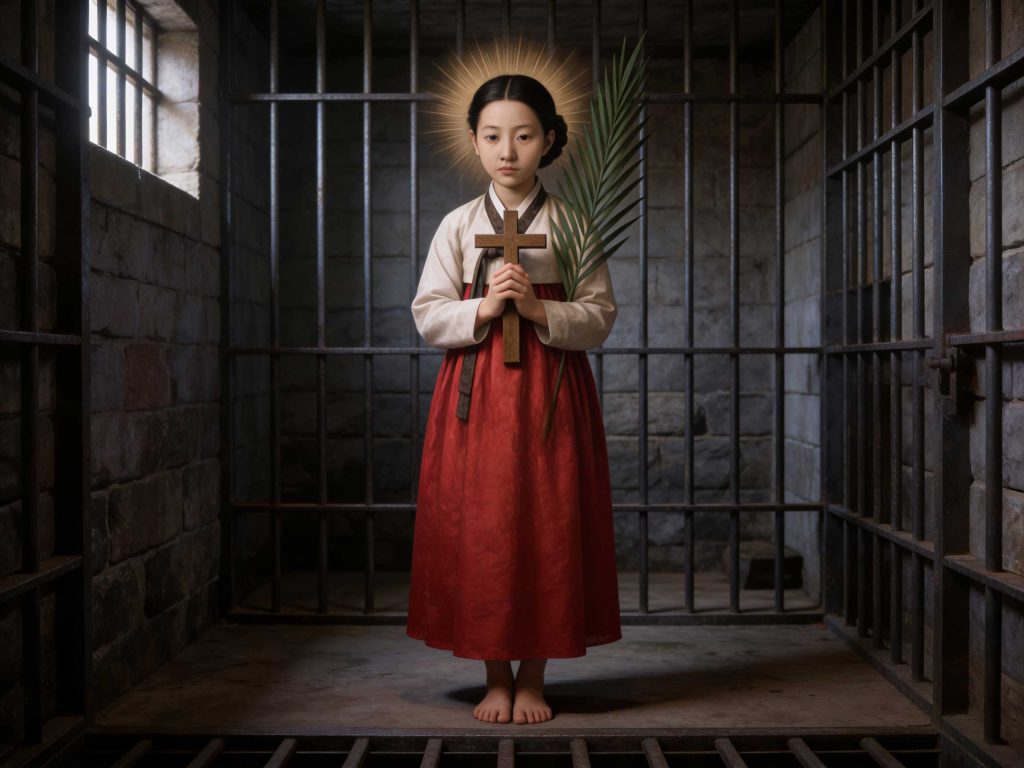
SEOUL, South Korea — In the records of the Church’s “hidden chapters,” few stories are as moving or as powerful as that of Saint Barbara Yi (Bareubara Yi). A young girl of just 14 years, Barbara became a beacon of “holy fearlessness” during the brutal Gihae Persecution of 1839, proving that the strength of faith is not measured by years, but by the depth of one’s “yes” to Christ.
Born in 1825 in Jeongpa, Seoul, Barbara grew up in a “domestic church” that was already well-acquainted with the Cross. Her family was part of the first generation of Korean Catholics who embraced the faith not through foreign missionaries, but through the study of Christian texts,a unique origin story in the history of global evangelization.
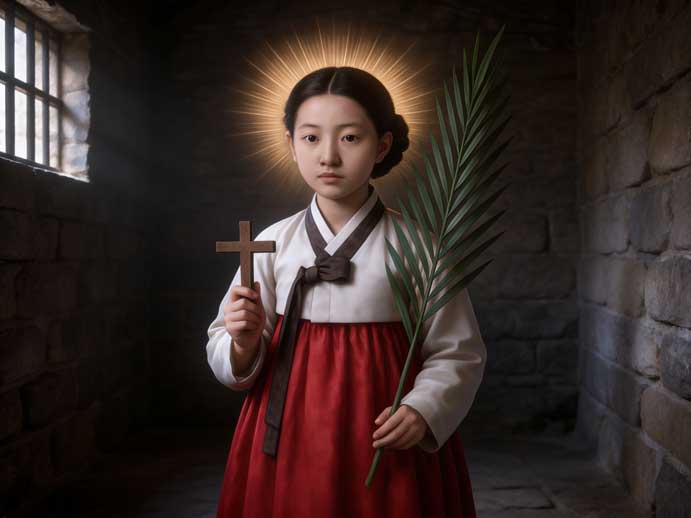
The Gihae Persecution: A Trial of Fire
The year 1839, known in the Korean lunar calendar as the year of Gihae, marked one of the most violent periods of anti-Christian sentiment in the Joseon Dynasty. The government, fearing the “subversive” nature of a faith that preached the equality of all people under God, launched a systematic campaign to eliminate the “foreign religion”.
Barbara was arrested along with her family, including her older sister, Saint Magdalene Yi Yong-hui. Despite her tender age, she was subjected to the same harsh conditions as the adult prisoners. The goal of the authorities was simple: to force a “denial of faith” through suffering. Yet, in the face of hunger, cold, and the constant threat of torture, Barbara remained a “lily among thorns,” her spirit unbroken by the darkness of her cell.
| Key Facts: Saint Barbara Yi | Details |
| Born | 1825, Jeongpa, Seoul, South Korea. |
| Died | May 27, 1839, in prison (Seoul) of plague/hardship. |
| Age at Martyrdom | 14 years old. |
| Beatified | July 5, 1925, by Pope Pius XI. |
| Canonized | May 6, 1984, by Pope St. John Paul II in Seoul. |
| Feast Day | May 27 (Individual); September 20 (Korean Martyrs). |
A Martyrdom of the Heart
While many of her companions were led to the execution grounds at Saenamteo or Seosomun, Barbara’s martyrdom took a different, though no less heroic, form. Weakened by the deplorable sanitary conditions of the prison, she contracted the plague. She died in her cell on May 27, 1839, offering her life as a “living sacrifice” for the Church in Korea.
Her death was a fulfillment of the words of the Psalmist: “Precious in the sight of the Lord is the death of his saints” (Psalm 116:15). Barbara’s witness was not found in a single dramatic moment of execution, but in the daily, quiet endurance of suffering for the sake of the Name of Jesus. She is remembered as one of the “virgin martyrs” who preferred the heavenly Bridegroom over the safety of a secular life.
The Legacy of the 103 Saints
Saint Barbara Yi was among the 103 Korean Martyrs canonized by Pope St. John Paul II during his historic visit to Seoul in 1984. This was the first canonization to take place outside of Rome in modern times, a “telling signal” of the importance of the Asian Church to the universal Body of Christ. During the ceremony, the Holy Father praised the “heroic constancy” of the Korean faithful, noting that their blood had become the “seed of a new springtime”.
Today, Saint Barbara Yi serves as a patroness for youth who face the “modern persecutions” of indifference and secularism. Her life reminds the faithful that even the smallest and most vulnerable among us can become a “stronghold of faith” when anchored in the Sacraments and the love of God.
As we reflect on the “holy hospitality” of Saint Barbara Yi’s heart, let us resolve to renew our own commitment to the Gospel, especially in times of trial. Let us resolve to:
- The Sacrament of Confession: To seek the “purity of heart” that allowed Barbara to see God even in the darkness of a prison cell.
- Eucharistic Adoration: To pray for the youth of the world, that they may find in Saint Barbara Yi a model of courage and “holy audacity.”
- The Holy Rosary: To entrust the “Church of Silence” and all persecuted Christians to the maternal protection of Mary, the Queen of Martyrs.
- The Holy Mass: To offer our participation in the Holy Sacrifice for the continued growth of the Church in Asia and for the reconciliation of the Korean peninsula.
- Sacred Scripture: To meditate on the words of Jesus: “Let the children come to me, and do not hinder them; for to such belongs the kingdom of heaven” (Matthew 19:14), seeking to maintain a child-like trust in God’s providence.
To remain informed about Catholic life, teachings, and global Church developments, readers may be encouraged to visit www.ewtnvatican.com for trusted Catholic news and resources.